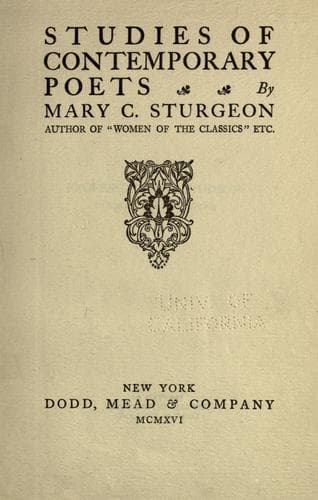
English poetry -- 20th century -- History and criticism
In the same poem of Etain we may note the free use of description and
the rich colour and profuse detail which mark romantic work of this
kind. The story of Etain has a mythological association. She was the
beloved wife of Mider, one of the ancient gods; but she seems to have
been driven out of the hierarchy and to have become incarnate in the
form of a young girl of great beauty. King Eochaidh, not knowing of her
divine origin, wooed her and made her queen. But Mider followed her to
earth and won her back from her human lover. There is an exquisite
stanza in which the King sends to seek for his bride, and tells how they
will find her--
"She shall be found in some most quiet place
Where Beauty sits all day beside her knee
And looks with happy envy on her face;
Where Virtue blushes, her own guilt to see,
And Grace learns new, sweet meanings from her grace;
Where all that ever was or will be wise
Pales at the burning wisdom of her eyes."
News is brought to the King that Etain is found, and he goes to the
remote and lonely place that his messengers have told him of. He comes
upon her unaware--
There by the sea, Etain his destined bride
Sat unabashed, unwitting of the sight
Of him who gazed upon her gleaming side,
Fair as the snowfall of a single night;
Her arms like foam upon the flowing tide;
Her curd-white limbs in all their beauty bare,
Straight as the rule of Dagda's carpenter.
There is, too, in this poetry of Mr Cousins, a very tender feeling for
Nature. Perhaps it does not quite accord with the spirit of the wild
time out of which the stories came; but that opens up a larger question
into which we are not bound to enter. For if we are going to quarrel
with the treatment of epic material in any but the vigorous, 'primitive'
manner, we shall make ourselves the poorer by rejecting much beautiful
poetry. We may even find ourselves robbed of Virgilian sweetness. But
most of us will be wise enough to take good things wherever we find
them; and may, therefore, rejoice in stanzas like these, which describe
the stirring of wild creatures at dawn:
Somewhere the snipe now taps his tiny drum;
The moth goes fluttering upward from the heath;
And where no lightest foot unmarked may come,
The rabbit, tiptoe, plies his shiny teeth
On luscious herbage; and with strident hum
The yellow bees, blustering from flower to flower,
Scatter from dew-filled cups a sparkling shower.
The meadowsweet shakes out its feathery mass;
And rumorous winds, that stir the silent eaves,
Bearing abroad faint perfumes as they pass,
Thrill with some wondrous tale the fluttering leaves,
And whisper secretly along the grass
Where gossamers, for day's triumphal march,
Hang out from blade to blade their diamond arch.
Public-domain text, read in full here on John Shaqi.
Reviews
Reviews
No reviews yet
Be the first to share your thoughts on this work.
Elsewhere in the archive
Join the Discussion
Join the discussion
Sign in to leave a comment or review.
Sign InorCreate an account