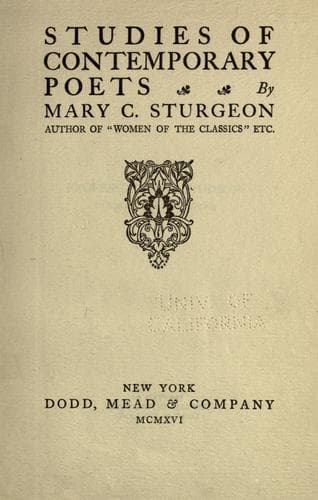
English poetry -- 20th century -- History and criticism
There is, however, a very different manner in which these early legends
are being treated by some of the Irish poets. One may call it 'Celtic,'
in the hope of conveying some impression of it in a single word. But if
you would get nearer than that, you may take one or two fragments from
Mr Yeats' _The Celtic Twilight_--such as "the voice of Celtic sadness
and of Celtic longing for infinite things ... the vast and vague
extravagance that lies at the bottom of the Celtic heart." And to
phrases like that, which adumbrate the spirit of the work, you must add
a style which is allusive, mystic, and symbolical: in fact, a mode of
expression rather like Mr Yeats' own early poetry. But the crux of the
matter lies there. For the production of really good work of this kind
demands just the equipment which Mr Yeats happens to possess: the right
temperament and the right degree (a high one) of poetic craftsmanship.
It is a rare combination--unique, of course, in so far as the element
of individuality enters. And attempts which have been made to gain the
same effects with a different natural endowment have failed in
proportion as temperament was unsuited or 'the capacity for taking
pains' was less. Hence 'Celtic' poetry, in the specific sense, has
fallen into some disfavour. Yet when mood and material and craft 'have
met and kissed each other,' it is clear that authentic beauty is
created; and that of a kind which cannot be made in any other way. Thus
we might choose, from the romantic work of Miss Eva Gore Booth, passages
where all the desirable qualities seem to meet. There is, for instance,
the poem which prefaces her _Triumph of Maeve_, from which I take the
last two stanzas. Here is finely caught that unrest of soul which we
have been taught to believe essentially Celtic; though it probably
haunts every imaginative mind, of whatever race.
There is no rest for the soul that has seen the wild eyes of Maeve;
No rest for the heart once caught in the net of her yellow hair--
No quiet for the fallen wind, no peace for the broken wave;
Rising and falling, falling and rising with soft sounds everywhere,
There is no rest for the soul that has seen the wild eyes of Maeve.
I have seen Maeve of the Battles wandering over the hill
And I know that the deed that is in my heart is her deed;
And my soul is blown about by the wild winds of her will,
For always the living must follow whither the dead would lead--
I have seen Maeve of the Battles wandering over the hill.
From the same romance we may select a speech by Fionavar, Queen Maeve's
beautiful young daughter. The sense of the supernatural enters here, for
the occasion is Samhain, the pagan All Souls' Eve. It is a night when
gods and fairies are abroad, and Fionavar has seen things strange and
awesome:
Public-domain text, read in full here on John Shaqi.
Reviews
Reviews
No reviews yet
Be the first to share your thoughts on this work.
Elsewhere in the archive
Join the Discussion
Join the discussion
Sign in to leave a comment or review.
Sign InorCreate an account