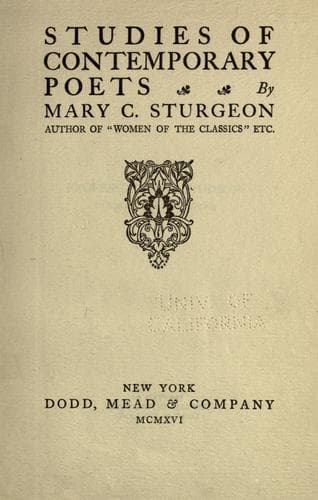
English poetry -- 20th century -- History and criticism
Now that undercurrent is not visible in a superficial glance at this
poetry. Even native critics seem to have missed it, or tend to refer it
to anything rather than to the whole movement of the national mind
towards reality. But that is not surprising, indeed. For the limpidity
of these lyrics is quite untroubled; they are innocent of ulterior
purpose, and free from the least chill of philosophical questioning into
origins or ends. The impulse out of which they came is instinctive:
their very art, at least in the selection of themes, is spontaneous. An
excellent example is the whole volume by Mr Joseph Campbell called _The
Mountainy Singer_. He has another, _Irishry_, but although that is very
interesting in its studies of Irish life, it is not so good as poetry,
nor is it so apt to our present purpose, because a tinge of
self-consciousness has crept into it. Let us take, however, the piece
which gives its name to the first of these two books:
I am the mountainy singer--
The voice of the peasant's dream,
The cry of the wind on the wooded hill,
The leap of the fish in the stream.
Quiet and love I sing--
The carn on the mountain crest,
The cailin in her lover's arms,
The child at its mother's breast.
.....
Sorrow and death I sing--
The canker come on the corn,
The fisher lost in the mountain loch,
The cry at the mouth of morn.
No other life I sing,
For I am sprung of the stock
That broke the hilly land for bread,
And built the nest in the rock!
That comes directly out of life, and the confidence and sincerity of it
are a result. The poet, become aware of the prompting of genius, loyally
follows its leading through the common and familiar things of human
experience. And partly because of his loyalty to himself; partly because
he happens to be in touch with the land--quite literally the oldest and
commonest thing of all, except the sea--there comes into his poetry a
sense of natural dignity and strength. His themes are simple and touched
with universal significance. Thus there is the song of ploughing:
I will go with my father a-ploughing
To the green field by the sea,
And the rooks and the crows and the seagulls
Will come flocking after me.
I will sing to the patient horses
With the lark in the white of the air,
And my father will sing the plough-song
That blesses the cleaving share.
One finds, too, a song of reaping, and one of winter, and one of night.
There is a love-song, pretty and tender, and fresh with the suggestion
of breezes and blue skies, which begins like this:
My little dark love is a wineberry,
As swarth and as sweet, I hold;
But as the dew on the wineberry
Her heart is a-cold.
There is a piece, in _Irishry_, which tells of the wonder of childhood,
and another in the same book which reverently touches the thought of
motherhood and old age:
Public-domain text, read in full here on John Shaqi.
Reviews
Reviews
No reviews yet
Be the first to share your thoughts on this work.
Elsewhere in the archive
Join the Discussion
Join the discussion
Sign in to leave a comment or review.
Sign InorCreate an account