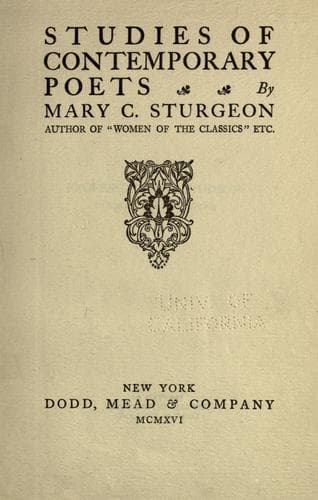
English poetry -- 20th century -- History and criticism
And Miss Gore-Booth, thinking of the sheltered ignorance of many women
who oppose the suffrage for their sex, makes a little parable:
The princess in her world-old tower pined
A prisoner, brazen-caged, without a gleam
Of sunlight, or a windowful of wind;
She lived but in a long lamp-lighted dream.
They brought her forth at last when she was old;
The sunlight on her blanchèd hair was shed
Too late to turn its silver into gold.
"Ah, shield me from this brazen glare!" she said.
Mr Cousins, too, has several noble sonnets on the theme, from which we
may select part of the one called "To the Suffragettes":
Who sets her shoulder to the Cross of Christ,
Lo! she shall wear sharp scorn upon her brow;
And she whose hand is put to Freedom's plough
May not with sleek Expediency make tryst:
.....
O fateful heralds, charged with Time's decree,
Whose feet with doom have compassed Error's wall;
Whose lips have blown the trump of Destiny
Till ancient thrones are shaking toward their fall;
Shout! for the Lord hath given to you the free
New age that comes with great new hope to all.
The main point of contrast, in turning to the more 'popular' lyrics, is
their simplicity. It is a difference of manner as well as of material.
You will not find in this verse either an elaborate metrical form, or
the treatment of questions such as that which we have just noted. Those
things belong to a more complex condition, both of life and of letters,
than that which is reflected here. And if such a contrast always implied
separation in time, we could believe ourselves to be in a different
epoch--a younger and more ingenuous age. But that, of course, by no
means follows. Even if we regard it as figured by a kind of separation
in space, with town and university on the one hand and the broad land
and toiling people on the other, it is still too arbitrary and,
moreover, it is incomplete. No room is found for the wanderers in
neutral territory.
The contrast is rather like that between the newer English poetry and
the old. It is indicative of a current of thought which is running
throughout Europe, and which may be observed in England, stimulating the
more vital work of contemporary poets. That, crudely stated, is a
perception of the value of life--of the whole of life, sense and spirit,
heart and brain and soul. As the poet is seized by it, he is carried
into a larger and more vivid world, one of manifold significance and
beauty which he had never before perceived. He grasps eagerly at _all_
the stuff of existence, persistently seeks his inspiration in life
instead of in literature, and having rejected the artifice of
conventional terminology, begins to create a new kind of poetry.
Public-domain text, read in full here on John Shaqi.
Reviews
Reviews
No reviews yet
Be the first to share your thoughts on this work.
Elsewhere in the archive
Join the Discussion
Join the discussion
Sign in to leave a comment or review.
Sign InorCreate an account