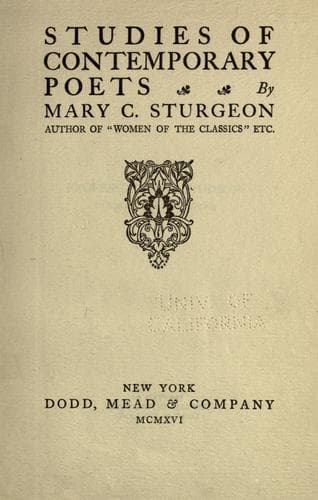
English poetry -- 20th century -- History and criticism
Once I loved a maiden fair,
_Over the hills and far away_.
Lands she had and lovers to spare,
_Over the hills and far away_.
And I was stooped and troubled sore,
And my face was pale, and the coat I wore
Was thin as my supper the night before.
_Over the hills and far away_.
.....
To-morrow, Mavourneen a sleeveen weds,
_Over the hills and far away_;
With corn in haggard and cattle in shed,
_Over the hills and far away_.
And I who have lost her--the dear, the rare,
Well, I got me this ballad to sing at the fair,
'Twill bring enough money to drown my care,
_Over the hills and far away_.
It is an arresting fact, however, that the spirit of nationality is
strong in the work of these poets. True, one may distinguish between a
national sense, keen and directly expressed, and the almost
subconscious influence of race. The first is a theme deliberately chosen
by the poet and variously treated by him. It is a conscious and direct
expression--of aspiration or regret. Racial influence is something
deeper and more constant: something, too, which quite confounds the
sceptic on this particular subject. Whether from inheritance or
environment, it has 'bred true' in these poets; and it will be found to
pervade their work like an atmosphere. It belongs inalienably to
themselves: it is of the essence of their genius, and it is revealed
everywhere, in little things as in great, in cadency and idiom as well
as in an attitude to life and a certain range of ideas.
But though we may make the distinction, it will hardly do to disengage
the strands, because they are so closely bound together. We may only
note the predominance of one or the other, with an occasional complete
and perfect combination. Perhaps the work in which they are least
obvious is the slim volume of Miss Ella Young. But, even here, and
choosing two poems where the artistic instinct has completely subdued
its material, we shall find some of the signs that we are looking for;
and not altogether _because_ we are looking for them. Thus a sonnet,
called "The Virgin Mother," suggests its origin in its very title and,
moreover, it is occupied with a thought of death and a sense of
blissful quietude which are familiar in Irish poetry.
Now Day's worn out, and Dusk has claimed a share
Of earth and sky and all the things that be,
I lay my tired head against your knee,
And feel your fingers smooth my tangled hair.
I loved you once, when I had heart to dare,
And sought you over many a land and sea;
Yet all the while you waited here for me
In a sweet stillness shut away from care.
I have no longing now, no dreams of bliss.
But drowsed in peace through the soft gloom I wait
Until the stars be kindled by God's breath;
For then you'll bend above me with the kiss
Earth's children long for when the hour grows late,
Mother of Consolation, Sovereign Death.
Public-domain text, read in full here on John Shaqi.
Reviews
Reviews
No reviews yet
Be the first to share your thoughts on this work.
Elsewhere in the archive
Join the Discussion
Join the discussion
Sign in to leave a comment or review.
Sign InorCreate an account