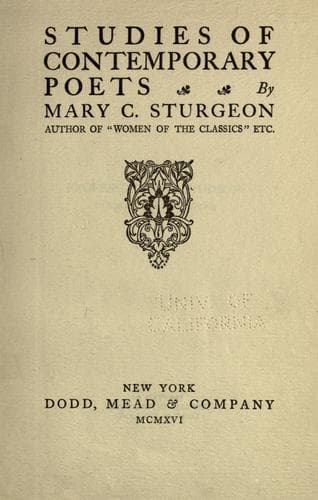
English poetry -- 20th century -- History and criticism
In the blank-verse piece called "Twilight" it is again the title which
conveys the direct sign of affinity, but it will also be found to lurk
in every line:
The sky is silver-pale with just one star,
One lonely wanderer from the shining host
Of Night's companions. Through the drowsy woods
The shadows creep and touch with quietness
The curling fern-heads and the ancient trees.
The sea is all a-glimmer with faint lights
That change and move as if the unseen prow
Of Niamh's galley cleft its waveless floor,
And Niamh stood there with the magic token,
The apple-branch with silver singing leaves.
The wind has stolen away as though it feared
To stir the fringes of her faery mantle
Dream-woven in the Land of Heart's Desire,
And all the world is hushed as though she called
Ossian again, and no one answered her.
Now that, in inspiration and imagery, is very clearly derived from
native legendary sources. But no one would expect to find in such work a
direct expression of national feeling. The backward-looking poet, the
one who is drawn instinctively to old themes and times, has not usually
the temper for politics, even on the higher plane. Or if he have, he
will make a rigid separation in style and treatment between his poetry
in the two kinds. Thus Miss Milligan sharply differentiates her lays on
heroic subjects from her lyrics. The lays try to catch the spirit of the
age out of which the stories came. The lyrics, as lyrics should, reflect
no other spirit than the poet's own. The lays are somewhat strict in
form: they are in a brisk narrative style, with a swinging rhythm and
plenty of vigour. The songs, depending on varying sense impressions and
fluctuating emotion, are more irregular as to form and, at the same
time, stronger in their appeal to human sympathy. It is in them that
the poet is able to express the passionate love of country which,
superimposed on a deep sense of Ireland's melancholy history and an
intense longing for freedom, is the birthright of so many Irish poets.
One would like to quote entire the lovely "Song of Freedom," in which
the poet hears in wind and wave and brook a joyous prophecy. But here is
the last stanza:
To Ara of Connacht's isles,
As I went sailing o'er the sea,
The wind's word, the brook's word,
The wave's word, was plain to me----
"_As we are, though she is not
As we are, shall Banba be----
There is no King can rule the wind
There is no fetter for the sea._"
More beautiful and significant, perhaps, is a fragment from "There Were
Trees in Tir-Conal":
Public-domain text, read in full here on John Shaqi.
Reviews
Reviews
No reviews yet
Be the first to share your thoughts on this work.
Elsewhere in the archive
Join the Discussion
Join the discussion
Sign in to leave a comment or review.
Sign InorCreate an account