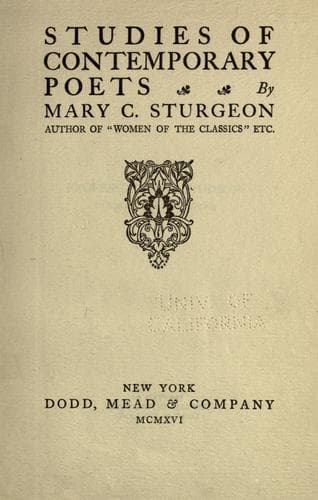
English poetry -- 20th century -- History and criticism
... From a sleep I emerge. I am clothed again with this woven
vesture of laws;
But I am not, and never again shall be the man that I was.
At the zenith of life I am born again, I begin.
Know ye, I am awake, outside and within.
I have heard, I have seen, I have known; I feel the bite of this
shackle of place and name,
And nothing can be the same.
.....
I have sent three shouts of freedom along the wind.
I have struck one hand of kinship in the hands of Gods, and one in
the hands of women and men.
I am awake. I shall never sleep again.
_Rose Macaulay_
There is one small volume of poems by Miss Macaulay, called _The Two
Blind Countries_. It is curiously interesting, since it may be regarded
as the testament of mysticism for the year of its appearance, nineteen
hundred and fourteen. That is, indeed, the most important fact about it;
though no one need begin to fear that he is to be fobbed off with
inferior poetry on that account. For the truth is that the artistic
value of this work is almost, if not quite, equal to the exceptional
power of abstraction that it evinces. Poetry has really been achieved
here, extremely individual in manner and in matter, and of a high order
of beauty.
One is compelled, however, though one may a little regret the
compulsion, to start from the fact of the poet's mystical tendency. Not
that she would mind, presumably; the title of her book is an avowal,
clear enough at a second glance, of its point of view. But the reader
has an instinct, in which the mere interpreter but follows him, to
accept a poem first as art rather than thought; and if he examine it at
all, to begin with what may be called its concrete beauty. I will not
say that the order is reversed in the case of Miss Macaulay's poetry,
since that would be to accuse her of an artistic crime of which she is
emphatically not guilty. But it is significant that the greater number
of pieces in this book impress the mind with the idea they convey,
simultaneously with the sounds in which it is expressed. And as the idea
is generally adventurous, and sometimes fantastic, it is that which
arrests the reader and on which he lingers, at any rate long enough to
discover its originality.
Public-domain text, read in full here on John Shaqi.
Reviews
Reviews
No reviews yet
Be the first to share your thoughts on this work.
Elsewhere in the archive
Join the Discussion
Join the discussion
Sign in to leave a comment or review.
Sign InorCreate an account