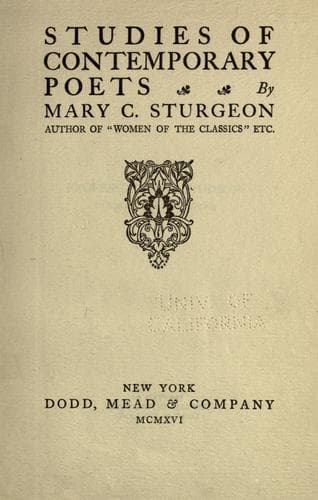
English poetry -- 20th century -- History and criticism
But though the mystical element of the work is suggested in its very
title, one discovers almost as early that it is mysticism of a new kind.
It belongs inalienably to this poet and is unmistakably of this age. The
world of matter, this jolly place of light and air and colour and human
faces, is vividly apprehended; but it is seen by the poet to be ringed
round by another realm which, though unsubstantial, is no less real.
Indeed, so strong is her consciousness of that other realm, and its
presence so insistently felt, that sometimes she is not sure to which of
the two she really belongs. In the first poem of the book, using the
fictive 'he' as its subject, she indicates her attitude to that region
beyond sense. In the physical world, this 'blind land' of 'shadows and
droll shapes,' the soul is an alien wanderer. Constantly it hears a
'clamorous whisper' from the other side of the door of sense, coming
from the
... muffled speech
Of a world of folk.
But no cry can reach those others: no clear sight can be had of them,
and no intelligible word of theirs can come back.
Only through a crack in the door's blind face
He would reach a thieving hand,
To draw some clue to his own strange place
From the other land.
But his closed hand came back emptily,
As a dream drops from him who wakes;
And naught might he know but how a muffled sea
In whispers breaks.
.....
On either side of a gray barrier
The two blind countries lie;
But he knew not which held him prisoner,
Nor yet know I.
This poem may be said to state the theme of the whole book. It would
appear, however, that in the difficult feat of giving form to thought so
intangible, the poet has attained here a detachment which is almost
cold. But it would be unfair to judge her manner of expression from one
poem; and it happens that there is another piece, built upon a similar
theme, which is much more characteristic. It is called "Foregrounds,"
and here again the two countries are conceived as bordering upon each
other, inter-penetrating, but sharply contrasted as night from day. The
contrast favours a more vivid setting, and the subjective treatment,
admitting deeper emotion, infuses a warmth that "The Alien" lacked.
Moreover, the psychic region is here called simply the _dream-country_;
and, presented in the delicate suggestion of a moonlit night, it hints
only at the lure of the mystery, and nothing of its terror. Throughout
the poem, too, runs exuberant joy in common earthly things, in the
beauty of nature and in human feeling; and this is followed, in the
closing lines of each stanza, by an afterthought and a touch of
melancholy: reflection coming, in the most natural way, close upon the
heels of emotion. Thus the first lines revel in the glory of spring; and
then, almost audibly, the tone drops to the lower level of one who
perceives that glory as the veil of something beyond it.
Public-domain text, read in full here on John Shaqi.
Reviews
Reviews
No reviews yet
Be the first to share your thoughts on this work.
Elsewhere in the archive
Join the Discussion
Join the discussion
Sign in to leave a comment or review.
Sign InorCreate an account