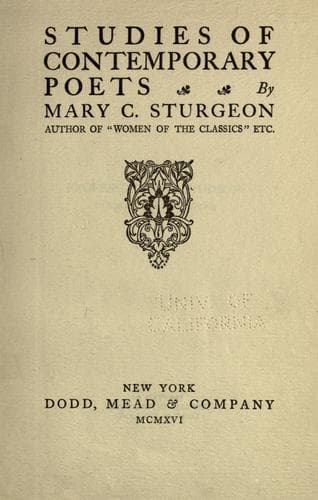
English poetry -- 20th century -- History and criticism
Hence comes a duality in which it is, perhaps, not too fanciful to see
a feature of contemporary thought--intensely interested in the region of
ideas, but frankly claiming the material world as the basis and
starting-point of all its speculation. One might put it colloquially
(though without the implied reproach) as making the best of both worlds:
humanity recognizing an honourable kinship with matter, but reaching out
continually after the larger existence which it confidently believes to
be latent in the physical world itself.
A voice may be raised to protest that that is too vaguely generalized;
and if so, the protestant may turn for more precise evidence to such
poems as "Trinity Sunday" and "The Devourers." There he will perceive,
after a moment's reflection, the store of modern knowledge--of actual
data--which has been assimilated to the mystical element here. Let him
consider, for example, the first two stanzas of "The Devourers," and
other similar passages:
Cambridge town is a beleaguered city;
For south and north, like a sea,
There beat on its gates, without haste or pity,
The downs and the fen country.
Cambridge towers, so old, so wise,
They were builded but yesterday,
Watched by sleepy gray secret eyes
That smiled as at children's play.
It is clear that the knowledge really has been assimilated--it is not a
fragmentary or external thing. It is absorbed into the essence of the
work and will not be found to mar its poetic values. But by a hint, a
word, a turn of expression or a mental gesture, one can see that
learning both scientific and humane (a significant union) has gone into
the poetic crucible. There are signs which point to a whole system of
philosophy: there is an historical sense, imaginatively handling the
data of cosmic history; and there are traces which lead down to a basis
in geology and anthropology. Yet these elements are, as I said,
perfectly fused: it would be difficult to disengage them. And inimical
as they may seem to the very nature of mysticism, they are constrained
by this poet to contribute to her vision of a world beyond sense.
Public-domain text, read in full here on John Shaqi.
Reviews
Reviews
No reviews yet
Be the first to share your thoughts on this work.
Elsewhere in the archive
Join the Discussion
Join the discussion
Sign in to leave a comment or review.
Sign InorCreate an account