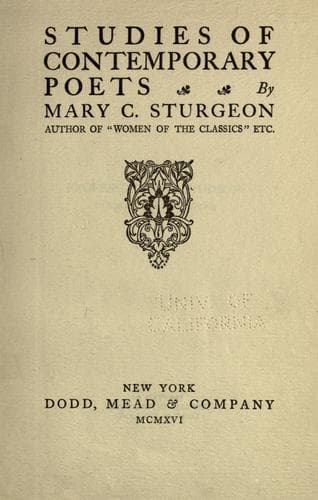
English poetry -- 20th century -- History and criticism
From this point of view "Trinity Sunday" is the most important poem in
the book. It records an experience which the mystic of another age would
have called a revelation, and which he would have apprehended through
the medium of religious emotion. But this poet attains to her ultimate
vision through the phenomena of the real world, apprehended in terms of
the ideal. The warm breath of Spring, rich with scent and sound of the
teeming earth, stirs it to awakening. But though she is walking in
familiar Cambridge with, characteristically, the scene and time exactly
placed: though friendly faces pass and cordial voices give a greeting,
all that suddenly shrivels at the touch of the wild earth spirit. Space
and time curl away in fold after fold; and with them pass successive
forms of strange life immensely remote. But even while reality thus
terribly unfolds, it is perceived to be the _stuff of the world's live
brain_; to have existence only in idea.
And the fens were not. (For fens are dreams
Dreamt by a race long dead;
And the earth is naught, and the sun but seems:
And so those who know have said.)
Thus the facts of science have gone to the making of this poem, as well
as the theories of an idealist philosophy. It is through them both that
imagination takes the forward leap. But neither the one nor the other
can avail to utter the revelation; and even the poet's remarkable gift
of expression can only suffice to suggest the awfulness of it.
So veil beyond veil illimitably lifted:
And I saw the world's naked face,
Before, reeling and baffled and blind, I drifted
Back within the bounds of space.
_John Masefield_
There is one sense at least in which Mr Masefield is the most important
figure amongst contemporary poets. For he has won the popular ear, he
has cast the poetic spell further than any of his compeers, and it has
been given to him to lure the multitudinous reader of magazines--that
wary host which is usually stampeded by the sight of a page of verse.
Now I know that there are cultured persons to whom this fact of
uncritical appreciation is an offence, and to them a writer bent upon
purely scientific criticism would be compelled to yield certain points.
But they would be mainly on finicking questions, as an occasional lapse
from fineness in thought or form, an incidental banality of word or
phrase; or a lack of delicate effects of rhyme and metre. And the whole
business would amount in the end to little more than a petulant
complaint; an impertinent grumble that Mr Masefield happens to be
himself and not, let us say, Mr Robert Bridges; that his individual
genius has carved its own channels and that, in effect, the music of the
sea or the mountain torrent does not happen to be the same thing as the
plash of a fountain in a valley.
Public-domain text, read in full here on John Shaqi.
Reviews
Reviews
No reviews yet
Be the first to share your thoughts on this work.
Elsewhere in the archive
Join the Discussion
Join the discussion
Sign in to leave a comment or review.
Sign InorCreate an account