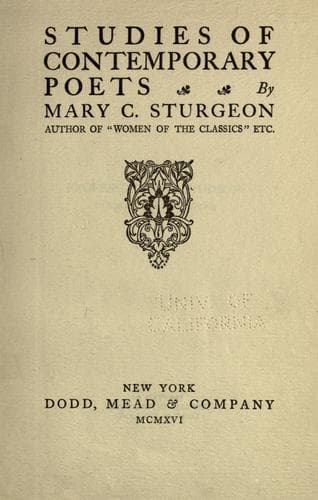
English poetry -- 20th century -- History and criticism
But, putting aside the prejudice which has been fostered by a
conventional poetic language, this realistic method does seem to
conflict with certain other characteristics of the work--with the
essential romance of the spirit of adventure, for instance. There does
at first glance appear to be a disturbing lack of unity between that
ardent, wistful and elusive spirit, and the grim actuality here, of
incident and diction; or, on the other hand, between the raw material of
this verse and its elaborate metrical form, or its frequent passages of
rare and delicate beauty. But is it more than an appearance? I think
not. I believe that the incongruity exists only in a canon of poetical
taste which is false to the extent that it is based too narrowly. That
canon has appropriated romance to a certain order of themes and, almost
as exclusively, to a certain manner of expression. Most of our
contemporary poets have cheerfully repudiated the convention so far as
it governed language; building up, each for himself, a fresh, rich,
expressive idiom in which the magic of romance is often vividly
recreated. Some of them, and Mr Masefield pre-eminently, have gone
further. They have perceived the potential romance of all life, and have
broken down the old limit which prescribed to the poet only graceful
figures and pseudo-heroic themes. They have set themselves to express
the wonder and mystery, the ecstasy and exaltation which inhere, however
obscurely, in the lowliest human existence.
Thus we have Saul Kane, the village wastrel of "The Everlasting Mercy,"
glimpsing his heritage, for a moment, in a lucid interval of a drunken
orgy. Suddenly, for a marvellous instant, he is made aware of beauty,
smitten into consciousness of himself and a fugitive apprehension of
reality.
I opened window wide and leaned
Out of that pigstye of the fiend
And felt a cool wind go like grace
About the sleeping market-place.
The clock struck three, and sweetly, slowly,
The bells chimed Holy, Holy, Holy;
.....
And summat made me think of things.
How long those ticking clocks had gone
From church and chapel, on and on,
Ticking the time out, ticking slow
To men and girls who'd come and go,
.....
And how a change had come. And then
I thought, "You tick to different men."
What with the fight and what with drinking
And being awake alone there thinking,
My mind began to carp and tetter,
"If this life's all, the beasts are better."
Public-domain text, read in full here on John Shaqi.
Reviews
Reviews
No reviews yet
Be the first to share your thoughts on this work.
Elsewhere in the archive
Join the Discussion
Join the discussion
Sign in to leave a comment or review.
Sign InorCreate an account