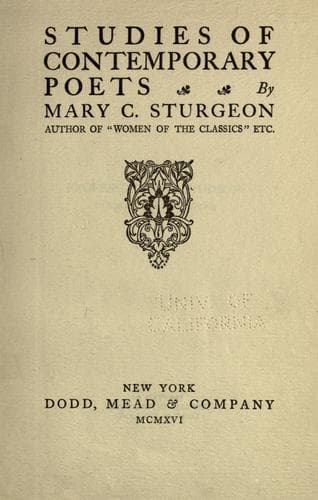
English poetry -- 20th century -- History and criticism
To-day without a song, without a word,
She seems to drag one piteous fallen wing
Along the ground, and, like a wounded bird,
Move silent, having lost the heart to sing.
She was young and blithe and fair,
Firm of purpose, sweet and strong,
Perfect was her crown of hair,
Perfect most of all her song.
One may cite a piece like that, breaking away, in the third stanza, to a
freer and more fitting rhythm, as an example of the normal development
of English prosody. And that is, perhaps, the final significance of Mr
Monro's work. With less temptation to waywardness than a more exuberant
genius, he has achieved a completer harmony. But it was not so easy a
task as the quiet manner would cheat one into supposing; and, of course,
it has not always been so successfully done. There are many
pieces--beautiful nevertheless--where external influences have not been
completely subdued. From them one may measure the strength with which
contemporary thought claims this poet. For it appears that he, too,
cannot be at ease in Zion; that he is troubled and ashamed by reason of
a social conscience; that he is haunted by an unappeasable questioning
spirit; that he is perpetually seeking after the spiritual element in
existence. Indeed, so clear and persistent is this last motive, that if
one were aiming epithets it would be possible to fit the word
'religious' to the essential nature of Mr Monro's poetry. Of course, no
poet, be he great or small, can be packed into the compass of a single
word. His work will mean much more, and sometimes greatly different from
that. And the word religious in this connexion is more than usually
hazardous, for almost all the connotations are against it. It is true
that the common meaning, bandied on the lips of happy irresponsibles,
has no application here. On the contrary, it seems sometimes completely
reversed; and the good unthinking folk would find themselves nonplussed
by such a piece as that called "The Poets are Waiting," in the chapbook
which Mr Munro published at the end of 1914. Yet it is of the essence of
religion; and it most faithfully presents the spiritual crisis which was
precipitated by the Great War for many who had clung to a last vague
hope of some intelligent providence--
To what God
Shall we chant
Our songs of Battle?
Hefty barbarians,
Roaring for war,
Are breaking upon us;
Clouds of their cavalry,
Waves of their infantry,
Mountains of guns.
Winged they are coming,
Plated and mailed,
Snorting their jargon.
Oh to whom shall a song of battle be chanted?
Not to our lord of the hosts on his ancient throne,
Drowsing the ages out in Heaven alone.
The celestial choirs are mute, the angels have fled:
Word is gone forth abroad that our lord is dead.
To what God
Shall we chant
Our songs of Battle?
Public-domain text, read in full here on John Shaqi.
Reviews
Reviews
No reviews yet
Be the first to share your thoughts on this work.
Elsewhere in the archive
Join the Discussion
Join the discussion
Sign in to leave a comment or review.
Sign InorCreate an account