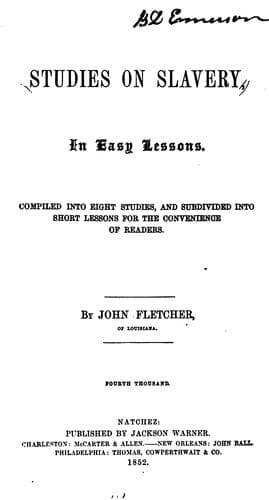
Abraham was obedient to the voice of God. His conduct was the antecedent
and the consequent was, God heaped upon him many blessings and among
them, riches in various things,—“_male and female slaves_,” some of whom
were “_born in his house_,” and some “_bought with his money_;” and God
made a covenant with him, granting him, and his seed after him, the land
of Canaan for an everlasting possession.
But this gift, as is the continuance of all other blessings, was
accompanied with a condition, which is well explained in _Genesis_,
xviii. 19: “For I know him, that he will command his children and _his
household_ after him, and they shall keep the way of the Lord to do
justice and judgment; that the Lord may bring upon Abraham that which he
hath spoken of him.”
Scholars will concede the fact that “_his household_” is a term by which
his slaves are particularly included, over whom his government was
extended; and, without its proper maintenance, the covenant so far on
his part would be broken.
From the wording of the covenant it is evident that Abraham had slaves
before the covenant was made, since it embraced regulations concerning
slaves, but, in no instance, hints that the existence of slavery was
adverse to the law of God, or that the holding of slaves, as slaves, was
contrary to his will. The deduction is, that slavery exists in the world
by Divine appointment; and that the act of owning slaves is in
conformity with the moral law.
The doctrine, that sin is the antecedent of slavery, is further
elucidated and made still more manifest by the recognition of the
institution by the biblical writers, where they place sin and slavery in
opposition to holiness and freedom:—thus, figuratively, making
righteousness the antecedent of freedom. “Stand fast, therefore, in the
liberty wherewith Christ has made us free, and be not entangled again
with the yoke of bondage.” _Gal._ v. 1. “And ye shall know the truth,
and the truth shall make you free.” _John_ iii. 32.
The abuse of slavery, like the abuse of any thing else, is doubtless a
great sin. Of the blessings God bestows on man, there is perhaps no one
he does not abuse; and while we examine the laws of God, as presenting
to the mind the vast field of cause and effect,—of antecedent and
consequent,—we may be led to a reflection on the necessity of a
conformity thereto, lest a long continuance of such abuses shall become
the antecedent to future calamities and woes, either to ourselves or
posterity; woes and calamities prefigured by those nations and tribes
already under the infliction of slavery, as a just punishment of sin.
Public-domain text, read in full here on John Shaqi.
Reviews
Reviews
No reviews yet
Be the first to share your thoughts on this work.
Join the Discussion
Join the discussion
Sign in to leave a comment or review.
Sign InorCreate an account