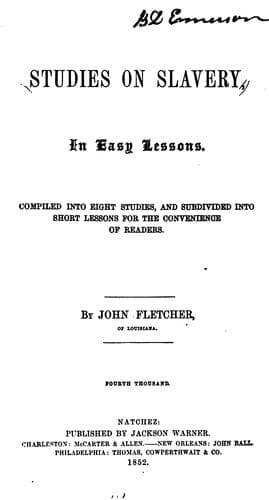
The time has come when the South must enter her plea of defence, not
because the accusers are foreign nations, of which it may justly be
said, before their charges are entertained, “Physician, heal thyself,”
but because our accusers are among our own brethren, bound to us by
freedom’s holiest associations and religion’s most sacred ties.
The author of the “Studies on Slavery” has the double advantage of a
full comprehension of the subject both in its Northern and Southern
aspect. Born and educated in the former, and qualified by a long
residence in the latter section of our Union, he is amply qualified to
weigh the prejudices, the teachings, and the arguments of the one,
against the facts, the justifications, the religious and political
sanctions of the other.
Mr. Fletcher has not only marshalled into his line of impregnable
defence the mandates and sanctions of the Sacred Writings concerning the
slave institutions, but he has drawn powerful auxiliaries from the
sources of ancient history. His exegesis of biblical passages, in the
original languages in which they were communicated by inspiration to the
world, shows his sound scholarship, as well as his reverence of the
literal sense and specific meaning of God’s holy and unimpeachable
standard and rule of life and action.
The author has also analyzed the fountain of Moral Philosophy, and
detected the bitter waters of error so industriously infused by the
eloquent and magical pens of such writers as Dr. Samuel Johnson, Dr.
Paley, Dr. Channing, Dr. Wayland, Mr. Barnes, and others. He has
confined himself to the moral and ethical bearings of the question,
scarcely touching upon its political aspects,—a course calculated to
render the book far more useful to the dispassionate seekers after
truth, who may belong to different political sects.
Neither time nor labour has been spared in the authorship of the work;
and it is believed that, while it is written with candour and calmness,
it will be received by the people of the North as well as of the South
as a sincere and enlightened endeavour to seek for truth, and thus allay
the tumultuous and disorganizing fanaticism of those who have not had
opportunity to study the subject, and are incapable of acting upon it
with understanding and true decision.
PROEMIAL
Philosophy knows no obligation that binds one man to another without an
equivalent. If one man could be subjected to another, who is not bound
to render any thing in return, it would be subversive to good morals and
political justice. Such a relation cannot exist, only so far as to reach
the immediate death of the subjected. But it has been the error of some
good men to suppose that slavery presented such a case. It has been
their misfortune also to receive the following succedaneums as axioms in
the search for truth:—
“All men are born equal.”
“The rights of men are inalienable.”
“No man has power to alienate a natural right.”
Public-domain text, read in full here on John Shaqi.
Reviews
Reviews
No reviews yet
Be the first to share your thoughts on this work.
Join the Discussion
Join the discussion
Sign in to leave a comment or review.
Sign InorCreate an account