“Servants are commanded to count their masters worthy of all honour,
that the name of God and his doctrine be not blasphemed. 1 _Tim._ vi.1.
That they may adorn the doctrine of God our Saviour in all things.
_Titus_ iii. 9.
“The manner in which the duty of servants or slaves is inculcated,
therefore, affords no ground for the assertion that the gospel
authorizes one man to hold another in bondage, any more than the command
to honour the king, when that king was Nero, authorized the tyranny of
the emperor; or the command to turn the other cheek when one was
smitten, justifies the infliction of violence by an injurious man.”
Added to the foregoing, we find the following note:
“I have retained the above paragraph, though I confess that the remarks
of Professor Taylor, of the Union Theological Seminary of Virginia, have
led me seriously to doubt whether the distinction, to which it alludes,
is sustained by the New Testament.”
Why then did he retain it?
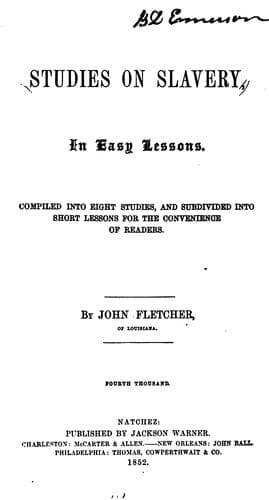
In his preface to the fourth edition, which is inserted in the present,
after expressing his acknowledgments for the criticisms with which
gentlemen have favoured him, he says—
“Where I have been convinced of error, I have altered the text. Where I
have only _doubted_, I have suffered it to remain; as it seemed
profitless merely to exchange one _doubtful_ opinion for another.”
We beg to know what _doubtful opinion_ would have been introduced by the
deletion of this, which he acknowledges to be doubtful? Why did he not
go to the Bible, and inquire of Jesus Christ and the apostles for advice
in such a case? “And immediately Jesus stretched forth his hand, and
caught him, and said unto him, O thou of little faith, wherefore didst
thou doubt?” _Matt._ xiv. 31.
In _Matt._ xxi. 21, we find that the doubting mind is destitute of
Christian power; and the same in _Mark_ xi. 23. Jesus, speaking to his
disciples, says to them, _Luke_ xii. 29, “Neither be ye of a doubtful
mind.” Does any one imagine that Luke would have left any thing in his
book that he thought doubtful? But we find in _Rom._ xiv. 1, “Him that
is weak in the faith receive ye, but not to doubtful disputations.” This
surely needs no comment. The poison of doubt is rejected in 1 _Tim._ ii.
8; and the apostle in _Rom._ xiv. 23, says, “And he that doubteth is
damned if he eat, because he eateth not of faith, for whatsoever is not
of faith is sin.” How awful is the condition of him who shall attempt to
preach a doctrine, and that an important one too, as the doctrine of the
Bible, of which he doubts! A doctrine in which he can have no faith! Who
shall say it would not be a palpable attempt to change the meaning and
alter the sense of the Scripture from its true interpretation?
“Ye shall not add unto the word which I command you, neither shall ye
diminish aught from it, that ye may keep the commandments of the Lord
your God, which I command you.” _Deut._ iv. 2.
Public-domain text, read in full here on John Shaqi.
Reviews
Reviews
No reviews yet
Be the first to share your thoughts on this work.
Join the Discussion
Join the discussion
Sign in to leave a comment or review.
Sign InorCreate an account