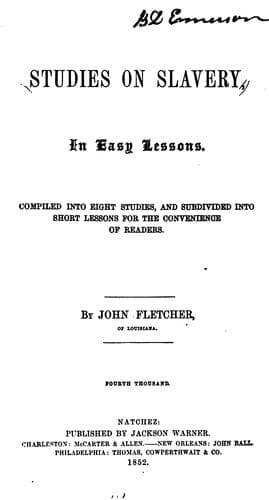
Dr. Paley thinks that the emancipation of slaves should be carried on
very gradually, by provision of law, under the protection of government;
and that Christianity should operate as an alterative, in which way, he
thinks, it has extinguished the Greek and Roman slavery, and also the
feudal tyranny; and he trusts, “as Christianity advances in the world,
it will banish what remains of this odious institution.”
In some of his other writings, Dr. Paley suggests that Great Britain, by
way of atoning for the wrongs she has done Africa, ought to transport
from America free negroes, the descendants of slaves, and give them
location in various parts of Africa, to serve as models for the
civilization of that country.
Dr. Paley’s Treatise on Moral and Political Philosophy, from which the
foregoing synopsis is taken, was published to the world in 1785; but it
had been delivered in lectures, almost _verbatim_, before the University
of Cambridge, several years previous; and it is now a class-book in
almost every high literary institution where the English language is
spoken. It is, therefore, a work of high authority and great influence.
But we think his definition of the term slavery is not correct. Let us
repeat it: “An obligation to labour for the benefit of the master,
without the contract or consent of the servant.”
Many, who purchase slaves to be retained in their own families, first
examine and consult with the slave, and tell him—“My business is thus; I
feed and clothe thus; are you willing that I should buy you? For I will
buy no slave who is not willing.”
To this, it is usual for the slave to say, “Yes, master! and I hope you
will buy me. I will be a good slave. You shall have no fault to find
with me, or my work.”
By all the claims of morality, here is a contract and consent, and the
statute might make it legal. But who will say that the condition of
slavery is altered thereby? But, says one, this supposition does not
reach the case, because all the obligations and conditions of slavery
previously existed; and, therefore, the “contract” and “consent” here
only amounted to a contract and consent to change masters.
Suppose then, from poverty or misfortune, or some peculiar affection of
the mind, a freeman should solicit to place himself in the condition of
slavery to one in whom he had sufficient confidence, (and we have known
such a case,)—a freeman anxiously applying to his more fortunate friend
to enter into such an engagement for life; suppose the law had
sanctioned such voluntary slavery, and, when entered into, made it
obligatory, binding, and final for ever. There would be nothing in such
law contrary to the general powers of legislation, however impolitic it
might be; and such a law did once exist among the Jews.
Public-domain text, read in full here on John Shaqi.
Reviews
Reviews
No reviews yet
Be the first to share your thoughts on this work.
Join the Discussion
Join the discussion
Sign in to leave a comment or review.
Sign InorCreate an account