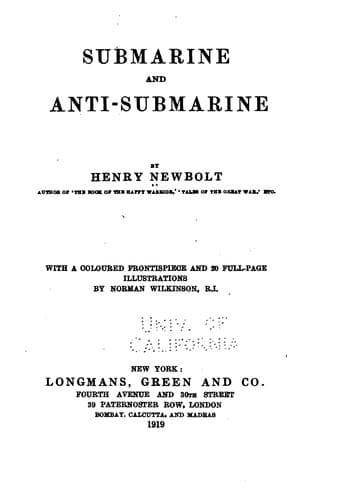
Submarine and Anti-submarineNewbolt, Henry John, Sir
History
Submarine and Anti-submarine
Newbolt, Henry John, Sir
Submarines (Ships); World War, 1914-1918 -- Naval operations -- Submarine
But this method, satisfactory as it is to the imagination, is involved
in several practical difficulties. If we put ourselves in the position
of a submarine commander with orders to go out and kill U-boats, we
shall quickly come up against some of the more obvious of these.
The sea is a large place; the submarine moves about it slowly, and
therefore takes a long time to patrol a given area. Also the very
worst point of view from which to survey that area is the eye-piece of
a periscope raised only some two feet above the surface. The strain
upon the eye is very severe, when hour after hour is spent in looking
for ships of ordinary size, with freeboard, funnels and streamers of
smoke. How much more severe, when the object to be looked for is a
conning-tower at most, with waves tumbling about it, or possibly only a
periscope 4 inches in diameter!
Let us suppose, however, that all the preliminary conditions are as
good as they can be; that the commander is in the best of health,
with sound nerves and good instruments, and that he is lucky enough
to sight a chance near the beginning of his cruise, while his eye is
unwearied and his judgment alert. He will still be hampered by two
considerations--he must make sure that the boat he is about to attack
is an enemy and not a friend, and he must take the not very remote risk
of being rammed, bombed, or depth-charged by a British destroyer or a
German seaplane, while his attention is fixed entirely on the chase.
Finally, there are the purely technical difficulties of the attack.
Manœuvring for position is not easy, even when the enemy is a large
and visible ship of war; it is ten times harder when he is a submerged
or nearly submerged vessel, and not steaming straight ahead, but
cruising about with sudden and erratic changes of course, as he
searches for or sights his intended victims. And here the nature and
habits of the torpedo have also to be considered. A periscope, or even
a conning-tower, is not a very good object for a distant shot. On the
other hand if the range is too short, say less than 250 yards, the
torpedo is very likely to miss. This is due to the fact that a torpedo
requires a certain length of run before it can settle to its course
evenly at the depth for which it is set. It begins by plunging, then
rises, sometimes even breaks surface, and finally takes its proper
depth, which may be set for anything from 6 to 22 feet. A torpedo fired
at a periscope must be set deep, for the submerged part of the boat
will be 15 feet or more below the surface. If it were fired at so short
a distance as 100 or 120 yards it would reach the target while still
on its upward bound, and might easily leap clean over the U-boat’s
rounded back. At a still less range, it would probably dive under the
enemy altogether. Moreover, up to a distance of 200 yards--or even
more--the explosion of a torpedo is dangerous to the attacker as well
as to the attacked. Water, being much less elastic than air, conveys
Public-domain text, read in full here on John Shaqi.
Reviews
Reviews
No reviews yet
Be the first to share your thoughts on this work.
Elsewhere in the archive
Join the Discussion
Join the discussion
Sign in to leave a comment or review.
Sign InorCreate an account