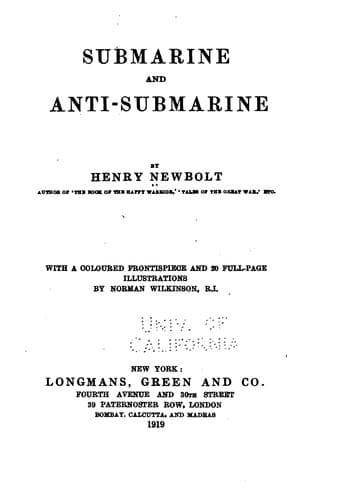
Submarine and Anti-submarineNewbolt, Henry John, Sir
History
Submarine and Anti-submarine
Newbolt, Henry John, Sir
Submarines (Ships); World War, 1914-1918 -- Naval operations -- Submarine
the shock of a blow far more completely; and of course, in such a case,
a submarine vessel, being entirely surrounded by water, would suffer
much more from the concussion than a ship with only part of its hull
below the surface.
If we take account of these obvious difficulties, and remember that
there are others of which we know nothing, we shall realise that the
destruction of a U-boat by one of our own submarines can only be
accomplished by a combination of skill, courage, and good fortune. The
examples which follow will make this clear.
Let us take first the case of E. 54, Lieutenant-Commander Robert
H. T. Raikes, which shows a record of two successes within less than
four months--one obtained with comparative ease, the other with great
difficulty. The first of the two needs no detailed account or comment.
E. 54, on passage to her patrol ground, had the good fortune to sight
three U-boats in succession before she had gone far from her base. At
two of these she fired without getting a hit; but the third she blew
all to pieces, and picked up out of the oil and debris no less than
seven prisoners. Her next adventure was a much more arduous one. She
started in mid-August on a seven-day cruise, and in the first four days
saw nothing more exciting than a neutral cruiser carrying out target
practice. On the morning of the fifth day, a U-boat was sighted at
last; and after twenty-five minutes’ manœuvring, two torpedoes were
fired at her, at a distance of 600 yards, with deflection for 11 knots.
Her actual speed turned out to be more nearly 6 or 7 knots, and both
shots must have missed ahead of her. She dived immediately, and a third
torpedo failed to catch her as she went down.
An hour and twenty minutes afterwards she reappeared on the surface,
and Lieut.-Commander Raikes tried to cut her off, by steering close
in to the bank by which she was evidently intending to pass. E. 54
grounded on the bank, and her commander got her off with feelings that
can be easily imagined. Less than an hour after, a U-boat--the same or
another--was sighted coming down the same deep. Again Lieut.-Commander
Raikes tried to cut her off, and again he grounded in the attempt. He
was forced to come to the surface when the enemy was still 2,000 yards
away. To complete his ill-fortune, another U-boat was sighted within an
hour and a quarter, but got away without a shot being possible.
Public-domain text, read in full here on John Shaqi.
Reviews
Reviews
No reviews yet
Be the first to share your thoughts on this work.
Elsewhere in the archive
Join the Discussion
Join the discussion
Sign in to leave a comment or review.
Sign InorCreate an account