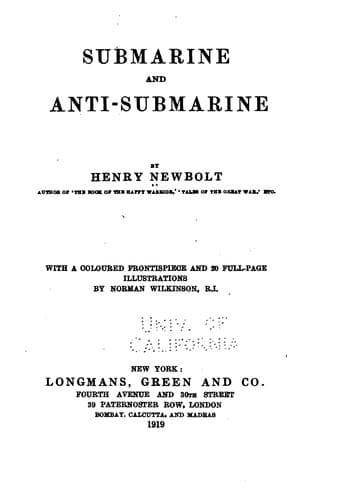
Submarine and Anti-submarineNewbolt, Henry John, Sir
History
Submarine and Anti-submarine
Newbolt, Henry John, Sir
Submarines (Ships); World War, 1914-1918 -- Naval operations -- Submarine
At 8 o’clock, then, on the finest summer morning of the year, Commander
Cooper was making his passage at normal surface speed, when the horizon
on his starboard bow began to be delicately shaded by faint pencilled
lines. Ten minutes more and a number of ships were visible, two points
on the bow, and five to six miles away. They were immediately in the
sun, and blurred by the haze, so that it was impossible to detect their
nationality. They might be our own squadron, coming back unexpectedly
early, or more likely a hostile force running from them. The only
thing certain was that they had sighted the submarine and were bent on
her destruction, for they were all bows on, bearing down upon her at
high speed--destroyers and cruisers--throwing up clouds of dense black
smoke.
Commander Cooper was in no indecent hurry, but he knew what he had to
do. He must get down, or be put down. Moreover, he must get well down;
for the water was very clear, and the sea flat calm, without a ripple.
After a last look at the charging squadron he dived to ninety feet,
changing his course to 185°.
His troubles began at once: the helm was reported jammed--it was
amidships. He sent the first-lieutenant to inspect, the report was
that the gear was all correct--the jamming seemed to be due to the
tightening of the rudder-post gland, either from external pressure,
or from some distortion of the after compartment of the ship. In any
case, nothing could be done for the moment, and there were plenty of
distractions coming. At 8.37 the sound of propellers was recorded on
the hydrophone--the destroyers were passing from port to starboard
overhead, like hounds abreast trying to pick up a scent.
One of them, must have thought she had hit it off, for a tremendous
explosion shook the submarine--a depth-charge had been dropped not far
behind her, shaking her stern violently. In her steering flat, the
first-lieutenant and his men were lifted bodily off their feet. The
commander continued his dive, and to his great comfort took bottom at
125 feet on the gauge.
Within three minutes of the first explosion, a second one followed.
It was equally violent, and to Commander Cooper appeared even louder;
but he told himself that this effect was probably due to the relative
position of the bomb, which had apparently detonated in a line with the
conning-tower. As he was himself in the control-room, in the centre of
the ship, the explosion would naturally sound louder, being on the
starboard beam instead of aft.
Public-domain text, read in full here on John Shaqi.
Reviews
Reviews
No reviews yet
Be the first to share your thoughts on this work.
Elsewhere in the archive
Join the Discussion
Join the discussion
Sign in to leave a comment or review.
Sign InorCreate an account