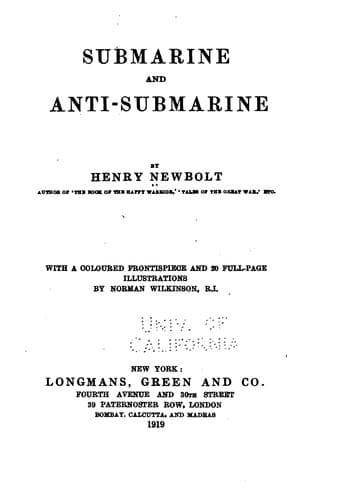
Submarine and Anti-submarineNewbolt, Henry John, Sir
History
Submarine and Anti-submarine
Newbolt, Henry John, Sir
Submarines (Ships); World War, 1914-1918 -- Naval operations -- Submarine
For those who sleep in beds and travel in buses, it is an almost
unimaginable life. ‘Yes,’ says the Admiral, ‘in this Service, officers
need a two-o’clock-in-the-morning courage every hour they are at sea:
and they have it.’
[Illustration: ‘Towed back by an enemy trawler.’]
The charts are put away. We move out, first to the gymnasium, where
physical drill is going on, then towards the great air-sheds. As we
approach the first of these, an officer meets us and hands a block to
the Admiral with the morning report upon it.
The Admiral’s face lights up as he reads. ‘A lucky chance--something
to interest you.’ The Beef Trip, it appears, which has just returned,
was escorted as usual by two seaplanes, flying ahead of the convoy. The
starboard one of these had sighted a submarine at 8.30 A.M. and swooped
towards her instantly. She was nearly submerged when the seaplane
passed over her, but the two big depth-charges which were dropped in a
flash, fell right into her wash and close to the conning-tower, which
disappeared in the explosion.
An excellent bit of work! But the face of the officer standing by shows
a distinct cloud. ‘What is it?’ Well, the fact is that the pilot of the
other seaplane, a mile and a half away to port, had an impression that
the submarine was British.
The pilot of the bomb-dropper is sent for and comes out at once--a
fair-haired and very young lieutenant, with an air of perfectly
undisturbed serenity. He is sure nothing is wrong--it is ‘only a
muddle.’ His companion pilot had certainly sighted and spoken a British
submarine some quarter of an hour earlier; but this was not the one.
Also another boat, E. 134, was out on patrol in that precise direction,
but she was not due in that spot till 11 o’clock, B.S.T., and it was
highly improbable she would be there so much before her time. Besides,
he knew the colour of a Hun conning-tower. Undoubtedly it was ‘only a
muddle.’ The explanation sounds a good one, but it is a speculation,
not a certainty; and on further inquiry, it appears that nothing has
since been heard of E. 134. The Admiral sends off the young pilot with
a word of good cheer; but when he has gone, he hands back the report
with a serious look. The incident has become too interesting. It is no
longer something to tell a visitor. We go into the sheds and spend the
remainder of our time in viewing the huge Americas and Handley-Pages.
Public-domain text, read in full here on John Shaqi.
Reviews
Reviews
No reviews yet
Be the first to share your thoughts on this work.
Join the Discussion
Join the discussion
Sign in to leave a comment or review.
Sign InorCreate an account