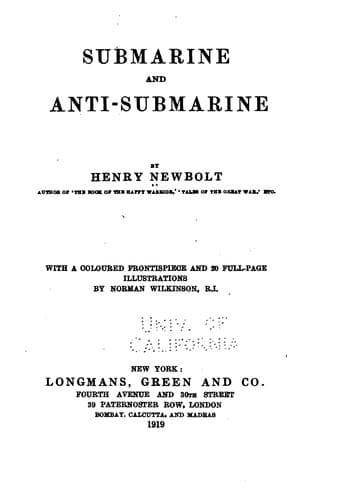
Submarine and Anti-submarineNewbolt, Henry John, Sir
History
Submarine and Anti-submarine
Newbolt, Henry John, Sir
Submarines (Ships); World War, 1914-1918 -- Naval operations -- Submarine
The object was to destroy the viaduct if possible; but, in any case,
to blow up part of the line. The risk involved not only the devoted
adventurer himself, but the boat as well, for she could not, so long
as he had still a chance of returning, quit the neighbourhood or even
conceal herself by submerging. The approach was in itself an operation
of the greatest delicacy. Commander Nasmith took his boat slowly
towards the shore until her nose just grounded, only three yards from
the rocks. The cliffs on each side were high enough to prevent the
conning-tower being seen while in this position. At 2.10 A.M. Lieut.
D’Oyly Hughes dropped into the water and swam off, pushing the raft
with his bale of gun-cotton, and his clothes and accoutrements, towards
a spot some sixty yards on the port bow of the boat. His weapons were
an automatic service revolver and a sharpened bayonet. He also had an
electric torch and a whistle. At the point where he landed he found the
cliffs unscalable. So he relaunched his raft and swam along to a better
place. He reached the top after a stiff climb, approached the railway
line by a careful prowl of half an hour, and went along it for five or
six hundred yards, hugging his heavy and cumbersome charge. Voices then
brought him up short. He peered about and saw three men sitting by the
side of the line. After watching them for some time he decided that
they were not likely to move, and that he must make a wide detour in
order to inspect the viaduct. He laid down his gun-cotton, and crept
inland, making good progress except for falling into a small farmyard,
where the fowls, but luckily not the household, awoke and protested. At
last he got within three hundred yards of the viaduct. It was easy to
see, for there was a fire burning at the near end of it; but there was
also a stationary engine working, and a number of workmen moving about.
Evidently it would be impossible to bring up and lay his charge there.
Public-domain text, read in full here on John Shaqi.
Reviews
Reviews
No reviews yet
Be the first to share your thoughts on this work.
Elsewhere in the archive
Join the Discussion
Join the discussion
Sign in to leave a comment or review.
Sign InorCreate an account