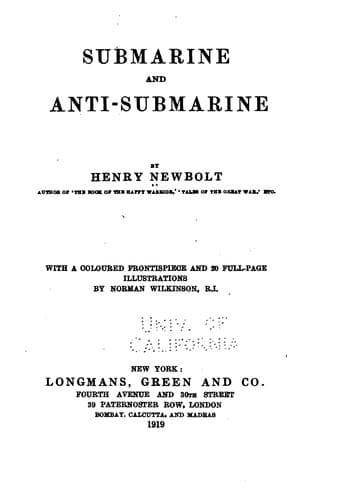
Submarine and Anti-submarineNewbolt, Henry John, Sir
History
Submarine and Anti-submarine
Newbolt, Henry John, Sir
Submarines (Ships); World War, 1914-1918 -- Naval operations -- Submarine
He crept back therefore to his gun-cotton and looked about for a
convenient spot to blow up the line. The best place seemed to be a low
brick-work support over a small hollow. It was only 150 yards from the
three men sitting by the line; but there was no other spot where so
much damage could be done, and Lieut. D’Oyly Hughes was a volunteer,
prepared to take risks. He muffled the pistol for firing the fuse as
tightly as possible, with a piece of rag, and pulled off. On so still
a night it made a very loud noise. The three Turks heard it and he saw
them instantly stand up. The next moment they were running down the
line, with Lieutenant D’Oyly Hughes going his best in front of them.
But a chase of this kind was not what he wanted. His present object
was to find a quiet spot on the shore where he could take to the water
undisturbed, and he had no time to lose. He turned on his pursuers and
fired a couple of shots; the Turks were not hit, but they remembered
their own weapons and began firing too, which was just the relief
Lieut. Hughes needed.
He had already decided against trying to climb down by the way he had
come up; but after a considerable run eastward, he struck the shore
more conveniently about three-quarters of a mile from the small bay in
which E. 11 was lying. As he plunged into the water, he had the joy of
hearing the sound of a heavy explosion. His charge had hung fire for a
long time, but when it went it went well; fragments were hurled between
a quarter and half a mile, and fell into the sea near the boat. There
could be no doubt that the line was effectively cut; and he could now
give his whole attention to saving an officer to the Service.
This was the most desperate part of the affair. After swimming some
four hundred or five hundred yards out to sea, he blew a long blast
on his whistle; but the boat was behind the cliffs in her little bay
and failed to hear him. Day was breaking rapidly; the time of waiting
for him must, he knew, be limited. With a decision and coolness beyond
comment he swam ashore again and rested for a short time on the
rocks--then swam off once more, directly towards the boat. Before he
reached the bay, he had to discard in turn his pistol, his bayonet, and
his electric torch. At last he rounded the point and his whistle was
heard; but, at the same moment, shouts came from the cliffs overhead,
and rifle fire opened on the boat.
Public-domain text, read in full here on John Shaqi.
Reviews
Reviews
No reviews yet
Be the first to share your thoughts on this work.
Elsewhere in the archive
Join the Discussion
Join the discussion
Sign in to leave a comment or review.
Sign InorCreate an account