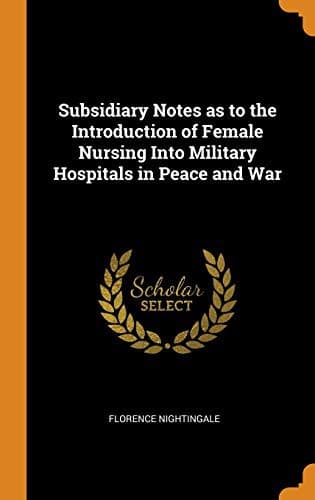
Subsidiary Notes as to the Introduction of Female Nursing into Military Hospitals in Peace and WarNightingale, Florence
History
Subsidiary Notes as to the Introduction of Female Nursing into Military Hospitals in Peace and War
Nightingale, Florence
Military hospitals -- Great Britain; Nurses -- Great Britain
The Widows were so instituted, about forty years or more ago, by Mary
of Wirtemberg, during so many years the venerated Empress-Mother. It is
quite possible that in the war-pressure their services proved rather
nondescript, they being neither sisters nor nurses, strictly speaking;
or perhaps the sole reason why Professor Pirogoff has not one good word
for them is, that they were not under his orders.
The Sisters of the Elevation of the Cross were a body of secular women,
with a few Sisters of Mercy, formed by the Grand Duchess Helena, and
placed by her under the orders of the famous civilian Surgeon Pirogoff,
to whom the supreme surgical command in Sevastopol was virtually
given. Several things are incidentally mentioned concerning them in
his pamphlet, quite inconsistent with the constitution of an ordinary
religious order.
One or two things in the pamphlet are incongruous enough to English
ideas:--the narrative given, however simply and succinctly, of the
performances of the sisters by name, the publication of the Professor’s
evident disagreement with the first “Oberin,” or Superior, who served
ten months, (the second, whom he so highly praises, had only served
two when he wrote); the improvement, by which the Sisters’ concerns
were “sat upon” by the Comité of Oberin, Chaplain, Doctor, and elder
Sisters, &c., &c.
But the division of Professor Pirogoff’s war-nurses into three
categories is a pregnant hint for future service, please God we yield
it. These three categories consisted of (1) the “Verband-Schwestern,”
or those who assisted the Surgeon in the dressings, and the
“Feld-scherer” (Dresser) in preparing them. (2) The “Apothekerinnen,”
or those who were in charge of all medical appliances for immediate
use, and who superintended the “Feld-scherer” (Dresser) in the
administration of medicines. (3) The “Wirthinnen,” who looked after
the diets, clean linen, &c., of the patients, and the order of the
hospital. Each “category” was responsible for carrying out the orders
of the medical officers. To every Hospital-_Baracke_ (hut) was attached
one sister of each of the above descriptions.
In ordinary service the less nurses know of each other’s wards the
better--in war service it is essential that as few women should serve
as many sick as possible; and it is impossible to attempt assigning to
each nurse the entire supervision of a ward. I think the categories,
modified, of course, and adapted to the Queen’s service, might be most
useful.
Public-domain text, read in full here on John Shaqi.
Reviews
Reviews
No reviews yet
Be the first to share your thoughts on this work.
Join the Discussion
Join the discussion
Sign in to leave a comment or review.
Sign InorCreate an account