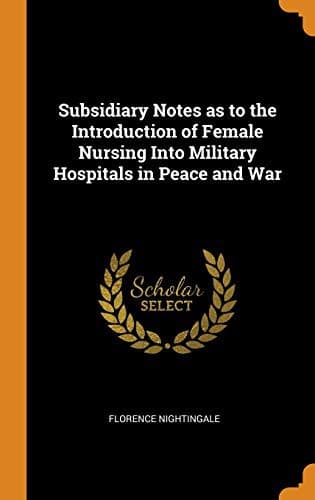
Subsidiary Notes as to the Introduction of Female Nursing into Military Hospitals in Peace and WarNightingale, Florence
History
Subsidiary Notes as to the Introduction of Female Nursing into Military Hospitals in Peace and War
Nightingale, Florence
Military hospitals -- Great Britain; Nurses -- Great Britain
In March 1856 the following appeared in “General Orders.” Had it but
been seventeen months earlier how much it might have saved![3] The
definition of the Superintendent-General’s powers and duties, therein
contained, is all that is wanted to prevent irregularities disastrous
to the Service.
GENERAL ORDERS.
_March 1856._
“It is notified, by order of the Secretary of State for War, that Miss
Nightingale is recognized by Her Majesty’s Government as the General
Superintendent of the Female Nursing Establishment of the Military
Hospitals of the Army. No lady, sister, or nurse is to be transmitted
from one Hospital to another, or into any Hospital, without previous
consultation with her. Her instructions, however, require her to have
the approval of the Principal Medical Officer, in her exercise of the
responsibility thus vested in her.
“The Principal Medical Officer will communicate with Miss Nightingale
upon all subjects connected with the Female Nursing Establishment, and
will give his directions through that lady.”
II.
_Nurses._
1. Our Nurses were of four sorts.
Nuns.
Sisters (Anglican).
Ladies.
Nurses.
The Nuns were received not as Nuns, but as Nurses.
Their (so called) training told sometimes against us; sometimes for us.
The same with the “Sisters” (Anglican).
The Ladies were useful, exactly in proportion as they approached the
professional, and not the dilettante, mode of thought.
A larger proportion of paid Nurses than of Ladies did well, and this
under circumstances of peculiar temptation. Paid Nurses are always the
most useful.
2. There should always be a proportion of Nurses in Army Hospitals
To preside in Extra Diet Kitchens,[4]
″ in Linen Stores.
To teach the Orderlies to nurse in the Wards.
The proportion of Roman Catholic “Sœurs,” in French Military Hospitals,
is as small as this would be; they undertake even less duty than this:
in Military Hospitals they do much less than in Civil Hospitals.
Women in Military Hospitals should all be contracted servants, whether
Nuns, Ladies, or professional Nurses.
There should be a retiring pension to each woman.
3. Miss Nightingale took service on the ground of being under the
Principal Medical Officer, and, consequently, of not interfering with
him.
There was no _imperium in imperio_ in her case.
This exists in the case of the French “Sœurs de Charité,” and existed
in individual instances among the “Sisters” under Miss Nightingale;
_i. e._, they gave articles of diet, &c., as from Sisters, not in
obedience to Medical orders. This was immediately put a stop to by
her. That the Medical Officer is sole master of diets, is an axiom of
medicine, and of common sense.
This involved our only _answering_ the Extra Diet Rolls in our
kitchens; not originating either in quantity or quality.
Public-domain text, read in full here on John Shaqi.
Reviews
Reviews
No reviews yet
Be the first to share your thoughts on this work.
Join the Discussion
Join the discussion
Sign in to leave a comment or review.
Sign InorCreate an account