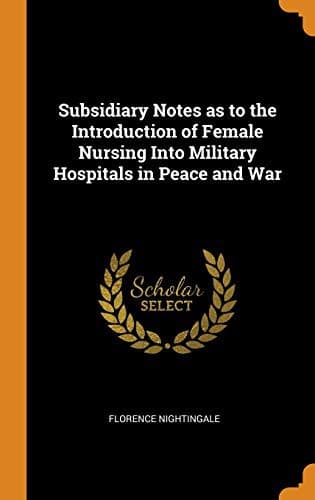
Subsidiary Notes as to the Introduction of Female Nursing into Military Hospitals in Peace and WarNightingale, Florence
History
Subsidiary Notes as to the Introduction of Female Nursing into Military Hospitals in Peace and War
Nightingale, Florence
Military hospitals -- Great Britain; Nurses -- Great Britain
Of these different ways, the first would be liked best by the women--a
thing to be considered, in subordination, and as a help to their
respectability and their efficiency--still it is, for some reasons
stated above, objectionable. However, in this, as in far more important
things, it is essential to consider everything as tentative and
experimental for some years to come. Do not be fettered by too many
rules at first: try different things, and see which answers best.
With regard to rations, it is as well to explain that there were two
ways of drawing them for the nurses during the war. In some of the
Crimean Hospitals, it was arranged that the same ration should be
drawn for a Nurse as that appointed by Regulation for a Medical Staff
Orderly. This answered, as may be supposed, exceedingly ill. There
was considerably more of some articles, such as bread and meat, than
the women could eat; and the surplus had to be wasted or returned to
the Purveyor--a serious complication. Of some articles, such as tea
and sugar, there was as much too little; and these had to be drawn as
extras, except such as the Superintendent-General found it easier and
more simple, as she generally did, to provide herself.
The other method was for the Local Superintendent to draw daily on the
Purveyor for such articles as she judged necessary; and by thus drawing
_en masse_, a considerable saving was, of course, effected for the
Queen, the tastes and health of women were consulted, and there was no
complication of accounts.
Where rations are to be drawn at all the latter method should be always
followed; and as the former might be understood by the word “rations,”
it would be better to call them by some other name, as it must be
obvious that such a method could never answer for women.
The experiment which I should wish to try, by which greater variety
could be secured, but which could only be practised where there was
a market at hand, would be for a commutation to be made of rations
for money. Each nurse to supply her quota of “mess money,” the “mess
money” to be all expended on the “mess,” and the Matron to manage the
“mess” day by day, and arrange for the cooking to be done in common. If
each nurse’s dinner is to be cooked separately, it necessarily entails
great waste of nourishment. The Nurses would not like this so well as
“finding themselves,” but it would ensure them a far better diet.[7]
[Sidenote: Wages and Mess-money must be distinct.]
Public-domain text, read in full here on John Shaqi.
Reviews
Reviews
No reviews yet
Be the first to share your thoughts on this work.
Join the Discussion
Join the discussion
Sign in to leave a comment or review.
Sign InorCreate an account