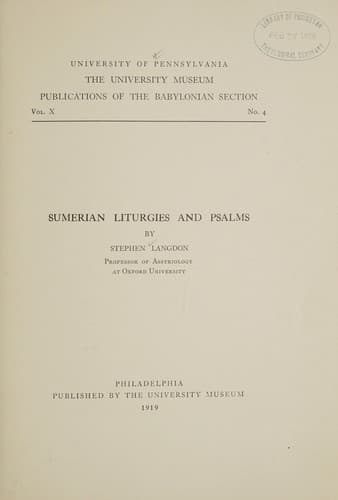
Hymns, Sumerian; Sumerian language -- Texts; Sumerians -- Religion
[Plate of cuneiform tablet.]
Plate XCII. 11. Obverse. Col. 4 Continued.
[Plate of cuneiform tablet.]
Plate XCIII. 11. Obverse. Col. 4 Final.
[Plate of cuneiform tablet.]
11. Obverse. Col. 5 Initial.
[Plate of cuneiform tablet.]
Plate XCIV. 11. Obverse. Col. 5 Continued.
[Plate of cuneiform tablet.]
Plate XCV. 11. Reverse. Col. 1. Initial.
[Plate of cuneiform tablet.]
Plate XCVI. 11. Reverse. Col. 1 Continued.
[Plate of cuneiform tablet.]
11. Reverse. Col. 2 Initial.
[Plate of cuneiform tablet.]
Plate XCVII. 11. Reverse. Col. 2 Continued.
[Plate of cuneiform tablet.]
11. Reverse. Col. 3. Initial.
[Plate of cuneiform tablet.]
Plate XCVIII. 11. Col. 3 Continued.
[Plate of cuneiform tablet.]
Plate XCIX. 12. Obverse. Cols. 1 and 2.
[Plate of cuneiform tablet.]
Plate C. 12. Reverse. Cols. 1 and 2.
[Plate of cuneiform tablet.]
Plate CI. 13. Obverse.
[Plate of cuneiform tablet.]
Plate CII. 13. Reverse.
[Plate of cuneiform tablet.]
Plate CIII. 14. Obverse. Col. 1
[Plate of cuneiform tablet.]
Plate CIV. 14. Obverse. Col. 2.
[Plate of cuneiform tablet.]
14. Reverse. Col. 1.
[Plate of cuneiform tablet.]
Plate CV. 14. Reverse. Col. 2.
[Plate of cuneiform tablet.]
FOOTNOTES
1 In addition to the examples of epical poems and hymns cited on pages
103-5 of this volume note the long mythological hymn to Innini, No.
3 and the hymn to Enlil, No. 10 of this part. An unpublished hymn to
Enlil, Ni. 9862, ends _a-a __d__En-lil zag-sal_, “O praise father
Enlil.” For Ni. 13859, cited above p. 104, see POEBEL, PBS. V No.
26.
2 So far as the term is properly applied. Being of didactic import it
was finally attached to grammatical texts in the phrase _d__Nidaba
zag-sal_, “O praise Nidaba,” i. e., praise the patroness of writing.
3 POEBEL, PBS. V No. 25; translated in the writer’s _Le Poème Sumérien
du Paradis_, 220-257. Note also a similar epical poem to Innini
partial duplicate of POEBEL No. 25 in MYHRMAN’S _Babylonian Hymns
and Prayers_, No. 1. Here also the principal actors are Enki, his
messenger Isimu, and “Holy Innini” as in the better preserved epic.
Both are poems on the exaltation of Innini.
4 Ni. 9205 published by BARTON, _Miscellaneous Babylonian
Inscriptions_, No. 4. This text is restored by a tablet of the late
period published by PINCHES in JRAS. 1919.
5 Ni. 7847, published in this part, No. 3 and partially translated on
pages 260-264.
Public-domain text, read in full here on John Shaqi.
Reviews
Reviews
No reviews yet
Be the first to share your thoughts on this work.
Elsewhere in the archive
Join the Discussion
Join the discussion
Sign in to leave a comment or review.
Sign InorCreate an account