_Mother-passion ... in the life of reptiles_: many readers,
seeing this statement in the “Atlantic Monthly,” where the
essay first appeared, have written me of how when they were
_boys_ they saw snakes swallow their young--or at least killed
the old snakes with young in them! Isn’t that mother-love among
the reptiles? But every time the story has been about garter
snakes or moccasins or some other ovoviviparous snake; that is,
a snake that does not lay eggs, but keeps them within her body
till they hatch, then _gives birth_ to the young. I have never
seen a snake swallow its young; though big snakes do _eat_
little ones whenever they can get them.
CHAPTER IX
FOR THE PUPIL
Mother Carey’s chickens are any of the small petrels. The little
_stormy petrels_ of poetry and story belong to the Old World and
only wander occasionally over to our side of the Atlantic.
PAGE 79
_petrel_: pronounced _pět´rel_, so called in allusion,
perhaps, to Saint Peter’s walking on the sea.
CHAPTER X
FOR THE PUPIL
PAGE 88
_P Ranch_: is one of the Hanley system of cattle ranches, which
cover a wide area almost seventy-five miles long. The buildings
and tree-fences, the stockades and sheds make it one of the most
picturesque I have ever seen. This story was told to me by Jack
Wade, the “boss of the buckaroos.” “Buckaroo” is a corruption of
the Spanish _vaquero_, cowherd.
_Winnemucca_: find the place on the map.
PAGE 91
_buckskin_: a horse of a soft yellowish color. He got his name
Peroxide Jim from the resemblance of the color of his coat to
that of human hair bleached by peroxide of hydrogen.
CHAPTER XI
FOR THE PUPIL
PAGE 100
_paper nests in trees_: The common yellow-jacket hornet builds
similar large round nests in bushes, and other wasps build paper
nests behind walls, under the ground, in holes, etc.
PAGE 107
_bite into something poisonous_: Send to the Department of
Agriculture at Washington for the little booklet on our
poisonous plants. It is free.
CHAPTER XII
TO THE TEACHER
Try to bring home to the class the profoundly interesting facts
of animal distribution--where they live, and how they came to
live where they do. Point out the strange shifts resorted to by
various creatures who live at the various extremes of height or
depth or cold or heat to enable them to get a living.
FOR THE PUPIL
PAGE 121
“_And God who clears_”: these lines of Kipling I am quoting as I
first found them printed. I see in his collected verse that they
are somewhat changed.
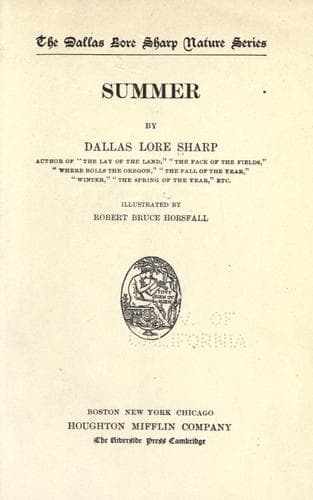
End of the Project Gutenberg EBook of Summer, by Dallas Lore Sharp
Public-domain text, read in full here on John Shaqi.
Reviews
Reviews
No reviews yet
Be the first to share your thoughts on this work.
Join the Discussion
Join the discussion
Sign in to leave a comment or review.
Sign InorCreate an account