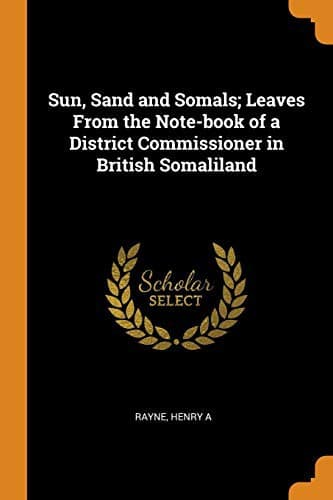
Sun, Sand and Somals: Leaves from the note-book of a District Commissioner in British Somaliland — John Shaqi
Sun, Sand and Somals: Leaves from the note-book of a District Commissioner in British SomalilandRayne, Henry A.
History
Sun, Sand and Somals: Leaves from the note-book of a District Commissioner in British Somaliland
Rayne, Henry A.
British Somaliland
"Aye, let us fight it out, Sahib," said Mahomed, reading my
thoughts, "things have gone too far; we _must_ fight."
"Very well," I reluctantly assented, "but your blood be on your own
head."
As I expected the Bantu simply smothered the Somal. Although we
barred sticks, knives, or stone-throwing (don't smile, Africans use
those things in preference to bare fists) there were many foul blows
given and received--more often received by Mahomed--until at last
the weaker man was in dire straits. Again and again he staggered to
his feet only to hit the ground immediately afterwards.
"Stop. Give in, Mahomed. He's a better man physically, and he'll
kill you!"
"I shall never give in," replied Mahomed. "He is a slave and I am
his master!"
And then the spirit in him began to triumph over his adversary, who,
though quite unhurt, now showed signs of fear. Once he fell to the
ground, and seizing Mahomed's leg bit it to the bone. For this act
he was rewarded by a kick on the face that gave him the wished-for
excuse to "play possum." The battered Mahomed now began to kick his
adversary feebly on the body with bare feet, and the latter cried
out to us to save him.
"Admit you are beaten!" said Mahomed.
"I am beaten!" said the Bantu.
Afterwards I married. The change of life from the single to the
blessed state affects not only the European dweller in Africa, but
also his servant. Where a wipe here and a flick there with a duster,
in the old days, constituted tidying up the house, everything now
must be cleaned and polished with scrupulous care. There are also
ever so many things that were never done in the old times more than
twice a year--and that a record year--that now call for attention
every day. A bachelor's servants rarely remain long with him after
he marries. But Mahomed was one of the exceptions. When the first
baby came he was as delighted as I, and when others followed he
seemed to share the heavy cares of family life equally with me. I
can pay him the greatest compliment a white man can pay the native.
Wherever the children might be I felt that if Mahomed were there,
and alive, they were safe. His own marriage to an older woman was
unhappy, and one day, yielding to her importunities, he allowed
her to go. She left him a young son. His mother had been rendered
destitute as the outcome of a wild raid by the Mad Mullah, and
Mahomed brought her, and a young brother, to Jubaland, where we
lived. I had then an opportunity of learning that he was a good son.
When war broke out in August, 1914, Mahomed and I, for the first few
days, took little heed. We were too far removed from the European
world to realise what was coming. But, soon afterwards, I left
Mahomed to help bring up the children, whilst I went off to join the
King's African Rifles.
Public-domain text, read in full here on John Shaqi.
Reviews
Reviews
No reviews yet
Be the first to share your thoughts on this work.
Join the Discussion
Join the discussion
Sign in to leave a comment or review.
Sign InorCreate an account