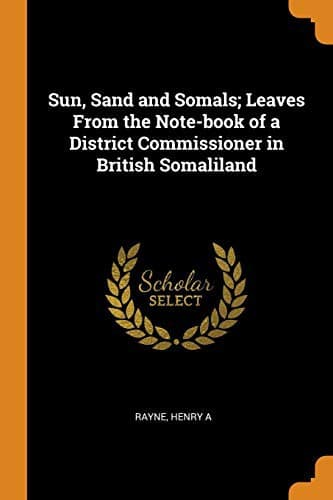
Sun, Sand and Somals: Leaves from the note-book of a District Commissioner in British Somaliland — John Shaqi
Sun, Sand and Somals: Leaves from the note-book of a District Commissioner in British SomalilandRayne, Henry A.
History
Sun, Sand and Somals: Leaves from the note-book of a District Commissioner in British Somaliland
Rayne, Henry A.
British Somaliland
The two Somal tribes coming directly under the Zeila agency were
the Gadabursi and the Issa, both with "unenviable reputations"
for treachery. As is the Somal custom each tribe is divided into
sections; each section into sub-sections and the sub-sections are
subdivided into _rers_ or families. The Somal is proud of his
pedigree, the average man being able to rattle off his family tree
without drawing breath, right back to his presumed Arab ancestors.
As a family of four or five brothers may marry four wives each,
as they often do, it follows, if they band together and have many
children, that quite a new _rer_ or Jilib may be formed. In this
way new and powerful _rers_ spring into existence, whilst old ones
are often wiped out. But the sections, and in a lesser degree
the sub-sections, rarely change. For this reason the British
found it convenient to continue the Egyptian system of employing
representatives of the various clans, or families, to act as agents
or go-betweens for the government among their own people. These
men are called Akils, and as, to-day, we have thirty-six Issa and
thirty-seven Gadabursi Akils on the district books, some idea of the
number of clans and families into which these tribes are divided may
be gathered.
The government utilises the system roughly thus: In Somaliland
instead of giving a man's address you state (_a_) his tribe, (_b_)
his tribal section, (_c_) his sub-section, (_d_) his _rer_ if
necessary. If he is wanted at court a biladier is sent to fetch
him; with the above information concerning his tribal history no
difficulty will be experienced in finding him, although the Somals
are the most nomadic of people, and continually on the move. He is
as well placed as Private Brown, of No. 1 Company, 1st Battalion,
fortieth Regiment of General Green's army in the X Y Z campaign.
Sometimes instead of sending a biladier to call him a wanted man's
Akil may be ordered to produce him.
He may, or may not, refuse to accompany the biladier. The Akil
may, or may not, produce him, but that does not affect the idea of
the system, which is quite sound in theory and as satisfactory in
practice as may be expected in a wild country like Somaliland. A
biladier is a man employed as a special constable on any odd job.
When sent into the district to call a man he is given a red ticket,
stamped with the court seal as a badge of authority, and the meaning
of this all Somals know. A man refusing to accompany him is nearly
always caught in the long run; often when visiting the town in the
belief that the affair has been forgotten and that he is safe; and,
in addition to the matter he was originally wanted for, he has to
answer the serious charge of refusing a biladier.
* * * * *
Public-domain text, read in full here on John Shaqi.
Reviews
Reviews
No reviews yet
Be the first to share your thoughts on this work.
Join the Discussion
Join the discussion
Sign in to leave a comment or review.
Sign InorCreate an account