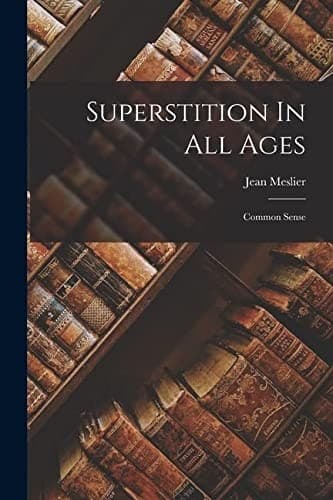
Superstition in all agesHolbach, Paul Henri Thiry, baron d'
Religion
Superstition in all ages
Holbach, Paul Henri Thiry, baron d'
Atheism
If everything is necessary, if errors, opinions, and ideas of men are
fated, how or why can we pretend to reform them? The errors of men are
the necessary results of their ignorance; their ignorance, their
obstinacy, their credulity, are the necessary results of their
inexperience, of their indifference, of their lack of reflection; the
same as congestion of the brain or lethargy are the natural effects of
some diseases. Truth, experience, reflection, reason, are the proper
remedies to cure ignorance, fanaticism, and follies; the same as
bleeding is good to soothe congestion of the brain. But you will say,
why does not truth produce this effect upon many of the sick heads?
There are some diseases which resist all remedies; it is impossible to
cure obstinate patients who refuse to take the remedies which are given
them; the interest of some men and the folly of others naturally oppose
them to the admission of truth. A cause produces its effect only when it
is not interrupted in its action by other causes which are stronger, or
which weaken the action of the first cause or render it useless. It is
entirely impossible to have the best arguments accepted by men who are
strongly interested in error; who are prejudiced in its favor; who
refuse to reflect; but it must necessarily be that truth undeceives the
honest souls who seek it in good faith. Truth is a cause; it produces
necessarily its effect when its impulse is not interrupted by causes
which suspend its effects.
LXXXIII.--CONTINUATION.
To take away from man his free will, is, we are told, to make of him a
pure machine, an automaton without liberty; there would exist in him
neither merit nor virtue What is merit in man?
It is a certain manner of acting which renders him estimable in the eyes
of his fellow beings. What is virtue? It is the disposition that causes
us to do good to others. What can there be contemptible in automatic
machines capable of producing such desirable effects? Marcus Aurelius
was a very useful spring to the vast machine of the Roman Empire. By
what right will a machine despise another machine, whose springs would
facilitate its own play? Good people are springs which assist society in
its tendency to happiness; wicked men are badly-formed springs, which
disturb the order, the progress, and harmony of society. If for its own
interests society loves and rewards the good, she hates, despises, and
removes the wicked, as useless or dangerous motors.
LXXXIV.--GOD HIMSELF, IF THERE WAS A GOD, WOULD NOT BE FREE; HENCE THE
USELESSNESS OF ALL RELIGION.
Public-domain text, read in full here on John Shaqi.
Reviews
Reviews
No reviews yet
Be the first to share your thoughts on this work.
Join the Discussion
Join the discussion
Sign in to leave a comment or review.
Sign InorCreate an account