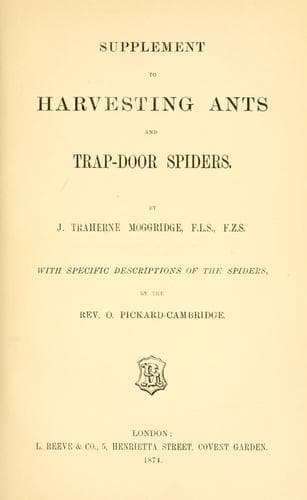
Supplement to Harvesting Ants and Trap-Door SpidersMoggridge, John Traherne
Science
Supplement to Harvesting Ants and Trap-Door Spiders
Moggridge, John Traherne
Ants; Trap-door spiders
It would be of interest to learn the extent and manner of concealment
of these large stores of grain, but, during the months from October
to May, I have never seen corn in any quantity in the granaries,
though there was frequent evidence of its late presence in the
dense masses of husks of oats and other large grain lying near the
nests. In October, 1873, I found near the entrances to a nest of
_structor_ a circular mound formed of this refuse, twenty-seven
inches in diameter, and averaging two inches in thickness, while
near other nests I have found the chinks between the stones of the
terrace-wall behind which the nest lay, literally stuffed with husks.
It was plain that these grains of cereals and the larger grasses
had been collected during the summer. The granaries in the winter
and spring contain the grains of some few of the autumnal grasses,
but are principally filled with seeds of the other more abundant
autumn-fruiting plants belonging to the neighbourhood.
I have now collected from the granaries of these ants the seeds or
small dry fruits of fifty-four distinct species of wild plants, and
on examination I find that during my stay in the south (from October
to May) the seeds of the distinctively spring and summer-flowering
plants are either entirely absent or are very scarce, while the
great bulk of the seeds belong to plants which ripen their fruits
in the autumn. Thus the grains of oats, of the large fescue and
brome grasses, of quaking grasses (_Melica_), and other kinds common
near the nests in May, are conspicuously absent in the winter, as
are the fruits of all the sedges but one, and this one (_Carex
distans_) retains its fruits till late in the autumn. Among other
spring-flowering plants common near the nests, the seeds of which
are also absent, I may mention violets (_Viola odorata_), poppies,
(_Papaver_), certain species of _Veronica_, _Helianthemum guttatum_,
_Silene quinque-vulnera_ and _Plantago Bellardi_.
Here a curious question arises--viz., What becomes of the large
stores of seeds which one may still find in the nests in May, when
the ants are busy pouring fresh supplies into the nest? The answer
probably is, that, as the weather becomes warmer, ever-increasing
calls are made by the larvæ upon the food-resources of the nest, and
that old and new seeds rapidly disappear together, and all the energy
and activity of the colony is needed to meet the increased demand.
Public-domain text, read in full here on John Shaqi.
Reviews
Reviews
No reviews yet
Be the first to share your thoughts on this work.
Join the Discussion
Join the discussion
Sign in to leave a comment or review.
Sign InorCreate an account