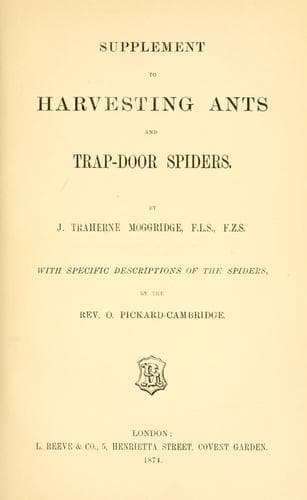
Supplement to Harvesting Ants and Trap-Door SpidersMoggridge, John Traherne
Science
Supplement to Harvesting Ants and Trap-Door Spiders
Moggridge, John Traherne
Ants; Trap-door spiders
I have often been asked whether I could give an approximate estimate
of the quantity of seeds contained in a nest of average size, but
I have hitherto felt unable to do this in a satisfactory manner. I
am now in possession of more reliable data, and believe that the
following calculation may be taken as a near approximation to the
truth. During the spring of 1873 I removed with but very little loss
the contents of two granaries from a very extensive nest of _Atta
structor_, consisting principally of seeds of clover, fumitory, and
pellitory. These seeds, when perfectly clean and freed from earth,
weighed in the one case 4 sc. 4 grs., and in the other 5 sc. 8 grs.
Now there cannot have been less than eighty such granaries in this
nest, so that, if we take five scruples as the average weight of the
seeds in each granary, and this, allowing for loss in collection,
which we may fairly do, we should have a total weight of more than
sixteen ounces, or one pound avoirdupois weight of seeds contained
in the nest. But, though this mass of seeds represents the result
of infinite labour on the part of the ants, each individual granary
contains but an insignificant quantity, and the store-chambers often
lie at great distances apart; it is therefore impossible to believe
that the stores alluded to in the Misna can have been as small and
scattered as these were, and we must, on the contrary, suppose them
to have been both larger and more accessible.[115]
[Footnote 115: Perhaps these heaps of corn may have been piled up at
the entrance to the nest, as is sometimes the case when the workers,
in their eagerness to secure as much as possible of a passing
harvest, bring in the supplies too fast for their companions within
the nest to be able to find room for and accommodate. When this
happens the seeds lie outside the nest until fresh chambers are
prepared for their reception.]
The means employed by the ants to prevent the germination of the
seeds contained in their granaries still remain secret, and all the
experiments and investigations which I have hitherto been able to
make have failed to give me the clue.
The problem to be solved is the following: Given seeds, the readiness
of which to germinate has been proved, to place them in damp soil at
depths varying from half an inch to twenty inches below the surface
in such a manner that they shall remain there dormant, neither
germinating nor decaying, for weeks and even months. These very seeds
must be capable of germinating after the conclusion of the experiment.
Public-domain text, read in full here on John Shaqi.
Reviews
Reviews
No reviews yet
Be the first to share your thoughts on this work.
Join the Discussion
Join the discussion
Sign in to leave a comment or review.
Sign InorCreate an account