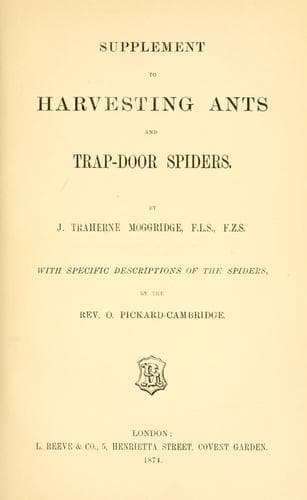
Supplement to Harvesting Ants and Trap-Door SpidersMoggridge, John Traherne
Science
Supplement to Harvesting Ants and Trap-Door Spiders
Moggridge, John Traherne
Ants; Trap-door spiders
I made other experiments in which harvesting ants were imprisoned
along with various seeds in small, cylindrical, closed vessels
containing a little damp sand. Here the vessels were frequently
rolled from side to side or shaken, during the twenty-two hours for
which the experiment lasted, so as to excite the ants and make them
give off such odours as they possessed, but no trace of injurious
influence was produced upon the seeds, which germinated and grew
normally afterwards.
At Mr. Darwin's suggestion I made a long series of experiments
with formic acid, in which measured quantities, pure or diluted,
were placed in a watch-glass on damp sand and surrounded by seeds,
the whole being enclosed in a covered tumbler, so that the effects
produced on the seeds by the vapour rising from the acid might be
noted. Similar seeds were sown at the same time and in the same
way, but without the acid, so as to permit of comparison. These
experiments have afforded some interesting results,[116] but do not
supply any positive data which might help us to discover the secret
of the ants. They narrow, indeed, the area in which search can
profitably be made, indicating as they do that the vapour of formic
acid is incapable of rendering the seeds dormant after the manner of
the ants, and showing, on the contrary, that its influence is always
injurious to the seeds, even when present only in excessively minute
quantities.
[Footnote 116: I hope shortly to offer these observations, together
with another series of a similar nature in which my friend Mr. J. B.
Andrews has taken part, to the Linnean Society.]
It appears to me now that the most promising field for experiments
made with a view to clearing up this difficulty, is that afforded by
the closer investigation of the phenomena of normal germination, and
by a study of the conditions under which seeds remain dormant, as
they are occasionally known to do, in situations which our general
experience would have selected as favourable to germination.
I have good hopes, also, that when we come to know more of the habits
of harvesting ants in tropical countries, and when naturalists have
excavated and described their subterranean stores--a thing which has
not yet been done as far as I know--we may gather fresh indications
to guide us in our search.
Public-domain text, read in full here on John Shaqi.
Reviews
Reviews
No reviews yet
Be the first to share your thoughts on this work.
Join the Discussion
Join the discussion
Sign in to leave a comment or review.
Sign InorCreate an account