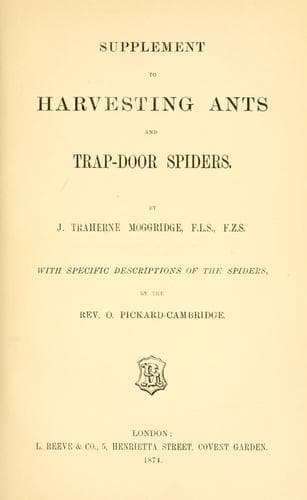
Supplement to Harvesting Ants and Trap-Door SpidersMoggridge, John Traherne
Science
Supplement to Harvesting Ants and Trap-Door Spiders
Moggridge, John Traherne
Ants; Trap-door spiders
The _abdomen_ is short-oval, and strongly convex above; it is of a
dull clay-coloured brown tinged with chocolate, and along the centre
of its upper side is a series of six strong angular bars or chevrons
of a dark chocolate-brown colour, and pretty distinctly defined,
though, when examined closely, broken in parts.
The intervening spaces between the angular bars and the sides have a
few irregular markings of a similar colour; and they are connected
by a longitudinal central line of the same hue running through their
apices.
The abdomen is very sparingly clothed with hairs and fine bristles;
the superior pair of spinners are strong; those of the inferior pair
very small and short.
Examples of this fine and very distinct spider were found at Bordeaux
in simple unbranched tubes, covered with a wafer-lid, running down
very deep into the earth, in some cases as much as fifteen inches
into an exceedingly hard soil, making it a work of great labour and
care to get them out without injury.
This species can scarcely be confused with any other yet known; its
short robust form, short legs, more elevated caput, general dark
colour, distinct angular bars on the abdomen, and almost contiguous
lateral eyes, as well as the form of the nest, will readily
distinguish it.
It is with great pleasure that I connect with this spider the name of
my most kind friend and brother arachnologist, Monsieur Eugène Simon,
to whom I am so greatly indebted for much information and numerous
examples of rare spiders.
I must not conclude these descriptions without expressing my sense of
obligation to Mr. Moggridge for so kindly allowing me to add them to
the far more popular, and more interesting, portion of this volume,
in which the _habits_ of these spiders are recorded.
Descriptions of _colour_, _form_, and _structure_ are but dry
details, though very necessary for the determination of species; and
in the present case it is very important as well as interesting to be
able to conclude with some certainty that differences of type in the
tubular nests of the spiders Mr. Moggridge has observed so closely
and accurately, are joined to well-marked specific differences
obtained from those other characters above mentioned, and which it
has been my endeavour to detail as fully and faithfully as possible.
INDEX TO SUPPLEMENT.
PART I.--HARVESTING ANTS.
Alyssocarpus, seeds of, collected by ants, 175
Amphisbæna, found in nests of Lauba ants, 177
_André_ (M. Ernest), on number of species of ants found in Europe,
160 (note)
_Arabia_, custom in, relative to ants, 176
Atta, species of, found in Europe, 160 (note);
_barbara_, 158;
found in Palestine, 165;
_megacephala_, 160;
_structor_, 158;
experiment with, 172;
found harvesting at Cadenabbia, 159
_Cadenabbia_, harvesting ants at, 159
Camponotus _sylvatica_, 178
Cicendela, capturing ants, 164
Coluocera _attæ_, found in ants' nests, 177
Public-domain text, read in full here on John Shaqi.
Reviews
Reviews
No reviews yet
Be the first to share your thoughts on this work.
Elsewhere in the archive
Join the Discussion
Join the discussion
Sign in to leave a comment or review.
Sign InorCreate an account