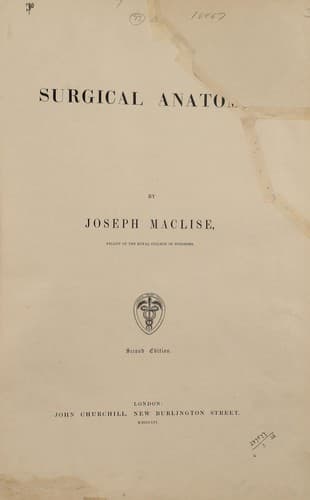
Anatomy, Surgical and topographical -- Atlases; Surgery -- Atlases; Surgery, Operative -- Atlases
The seat of stricture in an internal hernia may be either at the neck of
its sac, I, Plate 37, or at the external ring, T, Plate 38; and
according to the locality where this hernia enters the inguinal wall,
the nature of its stricture will vary. If the hernia pass through a
cleft in the conjoined tendon, f, Plate 38, this structure will
constrict its neck all around. If it pass on the outer margin of this
tendon, then the neck of the sac, bending inwards in order to gain the
external ring, will be constricted against the sharp resisting edge of
the tendon. Again, if the hernia enter the inguinal wall close to the
epigastric artery, it will find its way into the inguinal canal, become
invested by the structures forming this part, and here it may suffer
active constriction from the muscular fibres of the transverse and
internal oblique or their cremasteric parts. The external ring may be
considered as always causing some degree of pressure on the hernia which
passes through it.
In both kinds of inguinal herniae, the neck of the sac is described as
being occasionally the seat of stricture, and it certainly is so; but
never from a cause originating in itself per se, or independently of
adjacent structures. The form of the sac of a hernia is influenced by
the parts through which it passes, or which it pushes and elongates
before itself. Its neck, H, Plate 37, is narrow at the internal ring of
the fascia transversalis, because this ring is itself narrowed; it is
again narrowed at the external ring, T, Plate 36, from the same cause.
The neck of the sac of a direct hernia, I, Plate 37, being formed in the
space of the separated fibres of the conjoined tendon, or the pubic part
of the transversalis fascia, while the sac itself passes through the
resisting tendinous external ring, is equal to the capacities of these
outlets. But if these constricting outlets did not exist, the neck of
the sac would be also wanting. When, however, the neck of the sac has
existed in the embrace of these constricting parts for a considerable
period--when it suffers inflammation and undergoes chronic
thickening--then, even though we liberate the stricture of the internal
ring or the external, the neck of the sac will be found to maintain its
narrow diameter, and to have become itself a real seat of stricture. It
is in cases of this latter kind of stricture that experience has
demonstrated the necessity of opening the sac (a proceeding otherwise
not only needless, but objectionable) and dividing its constricted neck.
Public-domain text, read in full here on John Shaqi.
Reviews
Reviews
No reviews yet
Be the first to share your thoughts on this work.
Elsewhere in the archive
Join the Discussion
Join the discussion
Sign in to leave a comment or review.
Sign InorCreate an account