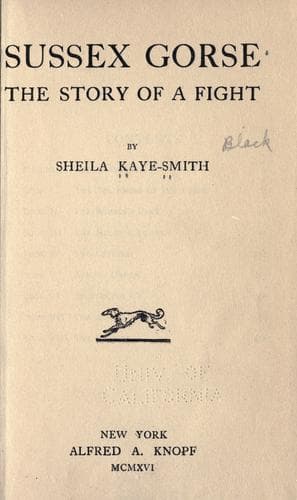
Sussex Gorse: The Story of a FightKaye-Smith, Sheila
General
Sussex Gorse: The Story of a Fight
Kaye-Smith, Sheila
Sussex (England) -- Fiction
She herself had no wish for motherhood, and expressed this so openly
that in time Reuben began to entertain dark doubts of her, and to feel
that she would avoid it if she could. Yet she in herself was so utterly
sweet that he could not find it in his heart to be angry, or use
anything but tender remonstrance when she vexed him with her attitude
towards life in general and marriage in particular.
She gulped at pleasure, and she gave him so much that he could not deny
her what she craved for, though the mere decorativeness of her tastes
amazed and sometimes appalled him. She coaxed him to buy her new
curtains and chair-covers for the parlour, and to turn it into a room
which could be used, where she could lounge in her pretty frocks, and
entertain her women-friends--of whom she had a startling number--to
afternoon tea, with cream, and little cakes that cost an amount of money
altogether disproportionate to the space that they filled in one's
inside. She demanded other entertainments too--visits to Rye, and even
to Hastings, and jaunts to fairs other than the sanctioned one on
Boarzell.
Reuben was delighted with her fashionable clothes, the dainty things
with which she managed to surround herself, her fastidious care for her
person, her pomadings, her soapings, her scentings--but he sometimes had
vague doubts of this beautiful, extravagant, irresponsible creature. He
was like a man stirring in a happy dream, realising in the midst of it
that he dreams, and must some day awake.
§ 7.
The year '71 was on the whole a bad one. The summer was parched, the
autumn sodden, and the winter frozen. Reuben's oats after some excellent
promises failed him abruptly, as was the way with crops on Boarzell. His
wheat was better in quality but poor in quantity, his mangolds had the
rot, and his hops, except for the old field by the lane, were brown and
ragged with blight.
This would have been bad enough in any year, but in times when he bore
the burden of his yet profitless milk-round it was only a little short
of catastrophe. Making every allowance for a first year, that milk-round
had disappointed him. He found private custom hard to win, and even the
ceasing of French dairy supplies, owing to the Franco-Prussian war, did
not bring him the relief he had hoped. One or two small farms on the
borders of Rye catered in dairy stuff for its inhabitants, and he found
them hard to outbid or outwit. Also, owing to the scarcity of grass
feed, it was a bad milk year, and poor supplies were put down by
consumers to the new milkman, and in more than one case custom was
withdrawn.
Public-domain text, read in full here on John Shaqi.
Reviews
Reviews
No reviews yet
Be the first to share your thoughts on this work.
Elsewhere in the archive
Join the Discussion
Join the discussion
Sign in to leave a comment or review.
Sign InorCreate an account