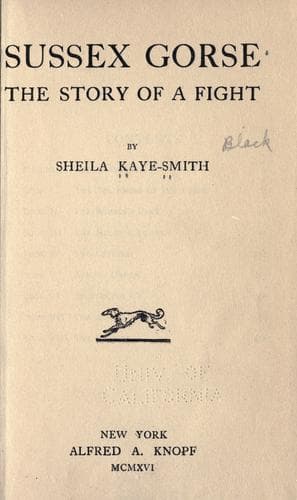
Sussex Gorse: The Story of a FightKaye-Smith, Sheila
General
Sussex Gorse: The Story of a Fight
Kaye-Smith, Sheila
Sussex (England) -- Fiction
Reuben faced his adversity with set teeth and a dogged countenance. He
had not been farming thirty odd years to be beaten casually by the
weather. Scorching heat and blighting cold, the still blanker doom of
the trickling, pouring rain--the wind that seeded his corn, and beat
down his hay, and flung his hop-bines together in muddled heaps--the
pests that Nature breeds by the ten million out of her own putrefyings
and misbegettings--all things in life from the lowest maggot to the
fiercest storm--he was out to fight them. In challenging Boarzell he had
challenged them all.
In time his struggle began to modify his relations with Rose. At first
he had told himself that her uselessness was only apparent. Though she
herself did no fighting, she gave such rest and refreshment to the
soldier that he went forth strengthened to the war. He had almost begun
to attribute to her his daily renewed courage, and had once or twice
been moved to show his gratitude by acts of expensive indulgence.
Now slowly he began to see that this gratitude was misleading--better
receive no comfort from Rose than pay for it too dear. He must make her
understand that he could not afford to keep a useless and extravagant
wife, however charming she might be. Rose must do her share, as Naomi
had done, as his mother had done, as his children had done.
Sometimes he would expostulate with her, and when she met his
expostulations with blandishments, he would feel himself yielding, and
grow so furious that he would turn upon her in rage and indignation.
Rose was not like Naomi; in her own words "she gave as good as she got,"
and once or twice, for the first time in his life, Reuben found himself
in loud and vulgar altercation with a female. He had never before had a
woman stand up to him, and the experience was humiliating.
He had used to turn from Boarzell to her for rest, and now he found
himself turning from her to Boarzell. It was part of the baffling
paradox that the thing he fought should also be the thing he loved, and
the battlefield his refuge. Out on the Moor, with the south-west wind
rolling over him like the waves of some huge earth-scented sea, he drank
in the spirit of conflict, he was swept back into the cleanness and
singleness of his warfare. It was then that Boarzell nerved him for its
own subduing, stripped his heart of softness, cleansed it of domestic
fret. Rose and her love and sweetness were all very well, but he was out
for something greater than Rose--he must keep in mind that she was only
a part of things. Why, he himself was only a part of things, and in his
cravings and softenings must be conquered and brushed aside even as
Rose. In challenging Boarzell he had challenged the secret forces of his
own body, all the riot of hope and weakness and desire that go to make a
man. The battle was not to be won except over the heaped bodies of the
slain, and on the summit of the heap would lie his own.
§ 8.
Public-domain text, read in full here on John Shaqi.
Reviews
Reviews
No reviews yet
Be the first to share your thoughts on this work.
Elsewhere in the archive
Join the Discussion
Join the discussion
Sign in to leave a comment or review.
Sign InorCreate an account