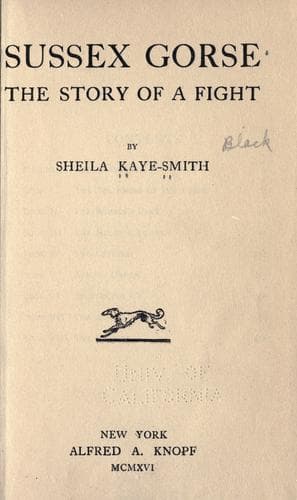
Sussex Gorse: The Story of a FightKaye-Smith, Sheila
General
Sussex Gorse: The Story of a Fight
Kaye-Smith, Sheila
Sussex (England) -- Fiction
The gipsies always camped on the flanks of the Fair, which they looked
on with greater detachment than the gaujos who crowded into its heart,
either selling or buying, doing or being done. Just within the
semicircle of their earth-coloured tents were the caravans of the
showmen, gaudily painted, with seedy horses at tether, very different
from the Romany gris. Then came the booths, stalls piled with sweets in
an interesting state of preservation, trays of neck and shoulder
ribbons, tinsel cords, tin lockets with glass stones, all fairings, to
be bought out of the hard-won wages of husbandry in love. Then there was
the panorama, creaking and torn in places, but still giving a realistic
picture of the crowning of King William; there was the merry-go-round,
trundled noisily by two sweating cart-horses; there was the cocoa-nut
shy, and the fighting booth, in the doorway of which half-breed Buck
Washington loved to stand and display his hairy chest between the folds
of his dressing-gown; and there was the shooting-gallery, where one
could pot at the cardboard effigies of one's hates, Lord Brougham who
had robbed the poor working man of his parish relief, or Boney, still a
blood-curdler to those who had seen the building of the Martello towers.
To-day business was bad. Here and there a ploughboy pulled up his slop
and fumbled for pennies in his corduroys, but for the most part the
stalls were deserted, even in certain cases by their holders. This was
not because the Fair was empty. On the contrary, it was much more
crowded than usual; but the crowd clotted into groups, all discussing
the same thing--the Inclosure.
It was some months since Sir John Bardon, Squire of the Manor of
Flightshot, had taken advantage of the Inclosure Act and manoeuvred a
bill for the inclosure of Boarzell. Since then there had been visits of
commissioners, roamings of surveyors, deliveries of schedules, strange
talk of turbary and estovers, fire-bote and house-bote. The
neighbourhood was troubled, perplexed. Then perplexity condensed into
indignation when all that Inclosure stood for became known--no more
pasturage for the cow or goat which meant all the difference between
wheaten and oaten bread, no more wood-gleanings for fire or wind-beaten
roof, no more of the tussocky grass for fodder, or of gorse to toughen
palings against escaping fowls.
Then, when Fair-time came, people began to mutter "no more Fair." It was
as hard to imagine Boarzell without the Fair as without its plume of
firs. The Squire gave out his intention of tolerating the Fair, as long
as it did not straggle from the crest. But this failed to soothe the
indignant and sore, for it was humbling to have the Fair as a matter of
toleration. Also at that time there was talk of fences. All the Moor had
been mapped out, the claims considered, the road repaired, and now
nothing more was to be done except to put up the fences which would
definitely seal Boarzell as Flightshot's own.
Public-domain text, read in full here on John Shaqi.
Reviews
Reviews
No reviews yet
Be the first to share your thoughts on this work.
Join the Discussion
Join the discussion
Sign in to leave a comment or review.
Sign InorCreate an account