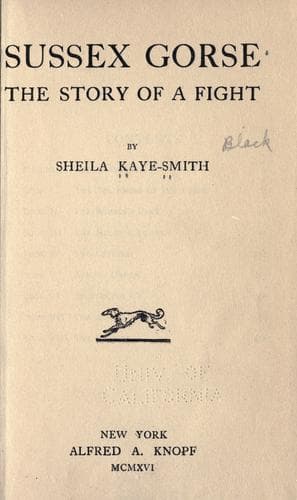
Sussex Gorse: The Story of a FightKaye-Smith, Sheila
General
Sussex Gorse: The Story of a Fight
Kaye-Smith, Sheila
Sussex (England) -- Fiction
Marriage was beginning to enter into his scheme. Some day he must marry
and beget children. As the farm grew he would want more hands to work
it, and he would like to think of others carrying on its greatness
after he was dead. He must marry a woman with money and with health, and
he was not so dustily utilitarian as not also to demand something of
youth and good looks.
Since his father's death he had denied himself woman's company, after
two years lived in the throb and sweetness of it. A warm and vigorous
temperament, controlled by a strong will, had promised a successful
libertinism, and more than once he had drunk the extasies of passion
without those dregs which spoil it for the more weakly dissolute. But
now, with that same fierce strength and relentless purpose which had
driven him to do the work of two men, to live hard, and sleep rough, he
renounced all the delights which were only just beginning. Henceforth,
with his great ambition before him, there could be nothing but
marriage--prudent, solid, and constructive. His girl at the Forstal knew
him no more, nor any of her kind. He had set himself to build a house,
and for the sake of that house there was nothing, whether of his own or
of others, that he could not tame, break down, and destroy.
§ 5.
By the end of the year Reuben had saved enough money to buy five acres
of Boarzell, in the low grounds down by Totease. He had saved chiefly on
the wages of Blackman and Becky, though, against that, he had been
forced to engage outside help for the hay in June, and also for the
wheat in August. However, he had been lucky enough to secure tramp
labour for this, which meant payment largely in barn-room and bread.
Then there had been a host of minor retrenchments, each in itself so
small as to be almost useless, but mounting together into something
profitable. Chocolate had vanished from the Odiam supper-table, their
bread was made of seconds, the genuines being sold to Iden Mill; they
ate no meat on week-days except bacon, and eggs were forbidden in
puddings. Reuben managed to get a small sale for his eggs and milk at
the Manor and the curate's house, though he had not enough cows and
poultry to make his dealing of much advantage.
Public-domain text, read in full here on John Shaqi.
Reviews
Reviews
No reviews yet
Be the first to share your thoughts on this work.
Join the Discussion
Join the discussion
Sign in to leave a comment or review.
Sign InorCreate an account