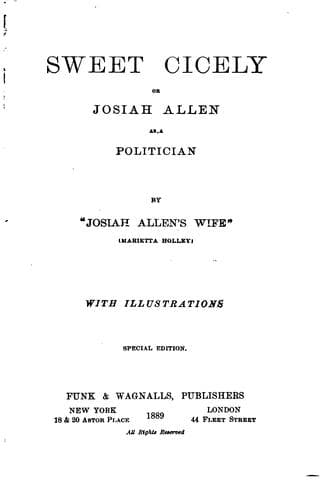
Sweet Cicely — or Josiah Allen as a PoliticianHolley, Marietta
Religion
Sweet Cicely — or Josiah Allen as a Politician
Holley, Marietta
Methodist Church (U.S.) -- Fiction; Temperance and religion -- Fiction; Women -- Suffrage -- Fiction
Says I, in awful axents, “It is very appropriate to have it right here
handy.” Says I, “Liquor does more towards makin' the laws of the United
States, from caucus to convention, than any thing else does; and it is
highly proper to have some liquor here handy, so they can soak the laws
in it right off, before they lay 'em onto the tables, or under 'em, or
pass 'em onto the people. It is highly appropriate,” says I.
“Yes,” says he. “It is very handy for the senators. And let me get you a
glass.”
“No, you won't,” says I firmly, “no, you won't. The nation suffers
enough from that room now, without havin' Josiah Allen's wife let in.”
Says he (his friendship for Bub Smith makin' him anxious and sot on
helpin' me), “If you have any feeling of delicacy in going in there, let
me make some wine here. I will get a glass of water, and make you some
pure grape wine, or French brandy, or corn or rye whiskey. I have all
the drugs right here.” And he took out a little box out of his pocket.
“My father is a importer of rare old wines, and I know just how it is
done. I have 'em all here,--capiscum, coculus Indicus, alum, coperas,
strychnine. I will make some of the choicest and purest imported liquors
we have in the country, in five minutes, if you say so.”
[Illustration: SAMANTHA REFUSING TO BE TREATED.]
“No,” says I firmly. “When I want to follow up Cleopatra's fashion, and
commit suicide, I am goin' to hire a rattlesnake, and take my poison as
she did, on the outside.”
“Cleopatra?” says he inquiringly. “Is she a Washington lady?”
And I says guardedly, “She has lots of relations here, I believe.”
“Wall,” he said, “he thought her name sounded familiar. Then, I can't do
any thing for you?” he says.
“Yes,” says I calmly: “you can open the front door, and let me out.”
Which he did, and I was glad enough to get out into the pure air.
When I got back to the house, I found they had been to supper. Sally had
had company that afternoon,--her husband's brother. He had jest left.
He lived only a few miles away, and had come in on the cars. Sally said
he wanted to stay and see me the worst kind: he wanted to throw out some
deep arguments aginst wimmen's suffrage. Says she, “He talks powerful
about it: he would have convinced you, without a doubt.”
“Wall,” says I, “why didn't he stay?”
She said he had to hurry home on account of business. He had come in
to the village, to get some money. There was goin' to be a lot of men,
wimmen, and children sold in his neighborhood the next mornin', and he
thought he should buy a girl, if he could find a likely one.
“Sold?” says I, in curious axents.
“Yes,” says Sally. “They sell the inmates of the poor-house, every year,
to the highest bidder,--sell their labor by the year. They have 'em get
up on a auction block, and hire a auctioneer, and sell 'em at so much a
head, to the crowd. Why, some of 'em bring as high as twenty dollars a
year, besides board.
[Illustration: BUYING TIME.]
Public-domain text, read in full here on John Shaqi.
Reviews
Reviews
No reviews yet
Be the first to share your thoughts on this work.
Elsewhere in the archive
Join the Discussion
Join the discussion
Sign in to leave a comment or review.
Sign InorCreate an account