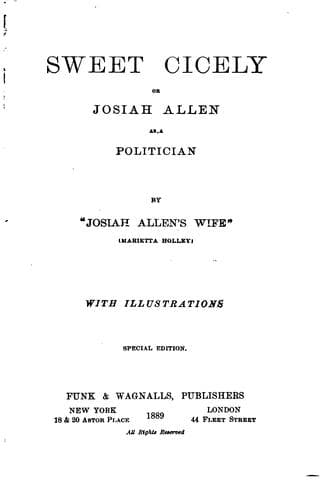
Sweet Cicely — or Josiah Allen as a PoliticianHolley, Marietta
Religion
Sweet Cicely — or Josiah Allen as a Politician
Holley, Marietta
Methodist Church (U.S.) -- Fiction; Temperance and religion -- Fiction; Women -- Suffrage -- Fiction
“Sometimes, he said, there was quite a run on old wimmen, and another
year on young ones. He didn't know but he might buy a old woman. He said
there was an old woman that he thought there was a good deal of work in,
yet. She had belonged to one of the first families in the State, and
had come down to poverty late in life, through the death of some of
her relations, and the villany of others. So he thought she had more
strength in her than if she had always been worked. He thought, if she
didn't fetch too big a price, he should buy her instead of a young one.
They was so balky, he said, young ones was, and would need more to eat,
bein' growin'. And she could do rough, heavy work, just as well as a
younger one, and probably wouldn't complain so much; and he thought she
would last a year, anyway. It was his way, he said, to put 'em right
through, and, when one wore out, get another one.”
I sithed; and says I, “I feel to lament that I wuzn't here so's he could
have converted me.” Says I, “A race of bein's, that make such laws as
these, hadn't ort to be disturbed by wimmen meddlin' with 'em.”
“Yes: that is what he said,” says Sally, in a innocent way.
I didn't say no more. Good land! Sally hain't to blame. But with a noble
scorn filling my eye, and floating out the strings of my head-dress, I
moved off to bed.
Wall, the next mornin' I sent Dorlesky's errents by Bub Smith to William
Wallace, for I felt a good deal fagged out. Bub did 'em well, and I know
it.
But William Wallace sent him to Gen. Logan.
And Gen. Logan said Grover Cleveland was the one to go to: he wuz a
sot man, and would do as he agreed. And Mr. Cleveland sent him to Mr.
Edmunds.
And Mr. Edmunds told him to go to Samuel G. Tilden, or Roswell P.
Flower.
And Mr. Flower sent him to William Walter Phelps.
And Mr. Phelps said that Benjamin P. Butler or Mr. Bayard was the one to
do the errent.
And Mr. Bayard sent him to somebody else, and somebody else sent him to
another one. And so it went on; and Bub Smith traipsed round, a carryin'
them errents, from one man to another, till he was most dead.
Why, he carried them errents round all day, walkin' afoot.
Bub said most every one of 'em said the errents wuz just and right, but
they couldn't do 'em, and wouldn't tell their reasons.
One or two, Bub said, opposed it, because they said right out plain,
“that they wanted to drink. They wanted to drink every thing they could,
and everywhere they could,--hard cider and beer, and brandy and whisky,
and every thing.”
And they didn't want wimmen to vote, because they liked to have the
power in their own hands: they loved to control things, and kinder boss
round--loved to dearly.
These was open-hearted men who spoke as they felt. But they was
exceptions. Most every one of 'em said they couldn't do it, and wouldn't
tell their reasons.
Public-domain text, read in full here on John Shaqi.
Reviews
Reviews
No reviews yet
Be the first to share your thoughts on this work.
Elsewhere in the archive
Join the Discussion
Join the discussion
Sign in to leave a comment or review.
Sign InorCreate an account