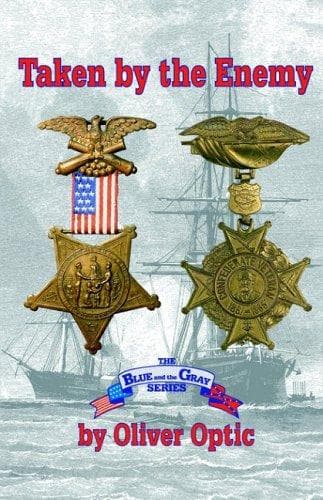
Brothers -- Juvenile fiction; Steamboats -- Juvenile fiction; United States -- History -- Civil War, 1861-1865 -- Juvenile fiction
To Captain Passford the question seemed to be settled; and he could no
longer doubt that his brother fully sympathized with the leaders of the
rebellion, if he was not one of them himself. He was certainly the most
enthusiastic person he had yet seen on that side of the question. But
Homer was thoroughly sincere, for he never was any thing else on any
subject.
Horatio was unable to understand how his brother could reason himself
into the belief that secession was right, when the duty of saving the
Union was to him paramount; and certainly Homer was equally puzzled over
the political faith of Horatio. Until the darkness of evening began to
gather, they argued the tremendous question; and they discussed it ably,
for both of them were thinking and reasoning men.
But, when the darkness gathered, they were not one hair's-breadth nearer
an agreement; and probably if they had continued to argue till morning,
or even till the end of the year, they would have come no nearer
together. Each had a sort of horror of the views of the other, though
they had lived in peace and harmony all the days of their lives.
"Homer, you are my brother; and I am sure that an unpleasant word never
passed between us," said Horatio, when the sun had gone down on the
fruitless discussion.
"Certainly not, brother; and it grieves me sorely to find that you are
upon one side, while I am on the other," replied Homer with a strong
manifestation of feeling. "I did not expect to see you at Glenfield; but
I felt sure that you would not be found, actually or constructively, in
the ranks of the enemies of the South."
"And I was equally sure that you would be found on the side of your
country,--the whole country, and not a miserable fraction of it," added
Horatio, with quite as much warmth as his brother. "I came here in the
Bellevite as much to convey you to a place of safety, as to restore
Florry to her mother."
"My country is here in the South. I have no other country; and I shall
stand by it to the last ditch, wherein I am ready to cast all that I
have and all that I am. If you thought it possible for me to desert the
cause of the South, you strangely misjudged me; and I do not feel at all
complimented by the formation of your opinion of me," said Homer, with a
trifle more of bitterness in his tone and manner than he had used
before.
"I see how it is with you, Homer; and I realize that it is worse than
folly for us to discuss this important question. Your mind is made up,
and so is mine; and I fear that we might quarrel if we should continue
to bandy words on the subject. We had better drop it entirely, once for
all."
"Perhaps we had; but it grieves me sorely, even to think of my only
brother taking part with the hirelings of the North in an attempt to
subdue the free, untamed, and untamable South. It would not hurt my
feelings more to know that you were a buccaneer, roving on the ocean
for the plunder of all nations."
Public-domain text, read in full here on John Shaqi.
Reviews
Reviews
No reviews yet
Be the first to share your thoughts on this work.
Join the Discussion
Join the discussion
Sign in to leave a comment or review.
Sign InorCreate an account