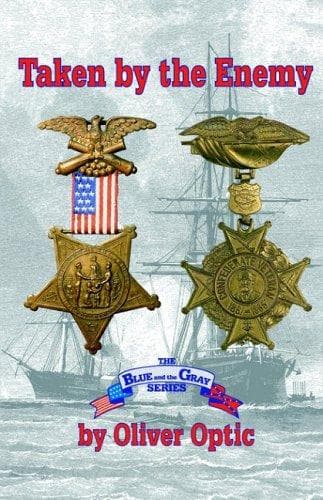
Brothers -- Juvenile fiction; Steamboats -- Juvenile fiction; United States -- History -- Civil War, 1861-1865 -- Juvenile fiction
"And then you present this fine vessel to the Yankee Government, and
doubtless the men on board of her will go into the service of the navy."
"I certainly expect as much as that of them."
"Then I question whether I ought to allow such a prize to pass out of
the bay for such a purpose," said Homer.
"Then, with such a doubt as that in your mind, I ought not to remain
here another hour," added Horatio quietly. "If you have gone far enough
in treason to betray your own brother, coming here to your home for no
warlike purpose, into the hands of the enemy, why, all I can do is to
look out for myself."
"I did not say that I should betray you, Horatio. It is simply a
question with me whether my duty to my country will allow me to let your
steamer leave these waters. I have not settled the question in my own
mind."
"I hope you will settle it soon. If I am to take my first step in this
fratricidal war by defending myself against my own brother, let him
speak, and I am ready," replied Horatio, shaken by an emotion deeper
than he had ever experienced before.
"Horatio, whatever you may do, whatever I may do, each in the discharge
of his duty to his country, his country as he understands it, let us
have no unfraternal feeling," continued Homer, almost as much disturbed
in his feelings as his brother.
"In other words, if you hand me and my vessel over to your leaders, and
consequently take from me the means of bearing my daughter to a place of
safety, I am to put my hand on my heart, and say that my brother has
done right, for I will not use any stronger terms," said Horatio,
struggling with his emotion.
"I must do my duty as I understand it," protested Homer. "The question I
put to myself is this: can I justify myself, before God and my country,
if I permit the finest steamer in the world, as you state it, to be
transferred to the Yankee navy, to be used in killing, ravaging, and
destroying within the free South? The steamer is here, and within my
reach. After all you have said, she would be the lawful prize of any
tug-boat in the bay that could capture her. I begin to realize that I
should be guilty of treason to my country in letting her go."
"You must be your own judge in regard to that," replied Horatio
bitterly, as he rose from his chair and walked towards the door.
"One word more, Horatio. I look upon the Bellevite as already belonging
to the Southern Confederacy. Of course, being a private yacht, she is
not armed?"
Homer paused and looked at his brother as though he expected an answer
to this question; but the owner of the steamer made no reply.
"Do you say that the Bellevite is armed, Horatio?" repeated Homer.
"I do not say any thing about it. I find that I am in the presence of an
enemy, though he is my own brother."
"Do not assume that tone to me, Horatio: it wounds me to the heart,"
said Homer, in a deprecatory tone. "If we are enemies because you choose
to oppress our people, I cannot help it; but we will still be brothers."
Public-domain text, read in full here on John Shaqi.
Reviews
Reviews
No reviews yet
Be the first to share your thoughts on this work.
Join the Discussion
Join the discussion
Sign in to leave a comment or review.
Sign InorCreate an account