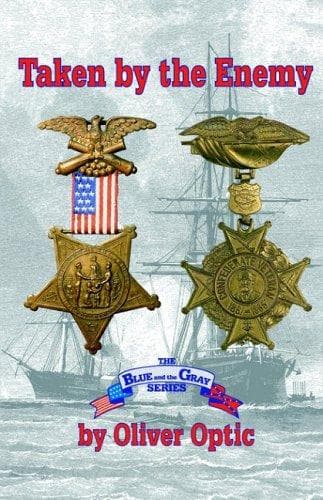
Brothers -- Juvenile fiction; Steamboats -- Juvenile fiction; United States -- History -- Civil War, 1861-1865 -- Juvenile fiction
Even five months before, when the Bellevite had sailed on her cruise,
the rumble of coming events had been heard in the United States; and it
had been an open question whether or not war would grow out of the
complications between the North and the South.
Only a few letters, and fewer newspapers, had reached the owner of
the yacht; and he and his family on board had been very indifferently
informed in regard to the progress of political events at home. Captain
Passford was one of those who confidently believed that no very serious
difficulty would result from the entanglements into which the country
had been plunged by the secession of the most of the Southern States.
He would not admit even to himself that war was possible; and before his
departure he had scouted the idea of a conflict with arms between the
brothers of the North and the brothers of the South, as he styled them.
Captain Passford had been the master of a ship in former times, though
he had accumulated his vast fortune after he abandoned the sea. His
father was an Englishman, who had come to the United States as a young
man, had married, raised his two sons, and died in the city of New York.
These two sons, Horatio and Homer, were respectively forty-five and
forty years of age. Both of them were married, and each of them had only
a son and a daughter. While Horatio had been remarkably successful in
his pursuit of wealth in the metropolis, he had kept himself clean and
honest, like so many of the wealthy men of the great city. When he
retired from active business, he settled at Bonnydale on the Hudson.
His brother had been less successful as a business-man, and soon
after his marriage to a Northern lady he had purchased a plantation in
Alabama, where both of his children had been born, and where he was a
man of high standing, with wealth enough to maintain his position in
luxury, though his fortune was insignificant compared with that of his
brother.
Between the two brothers and their families the most kindly relations
had always existed; and each made occasional visits to the other, though
the distance which separated them was too great to permit of very
frequent exchanges personally of brotherly love and kindness.
Possibly the fraternal feeling which subsisted between the two brothers
had some influence upon the opinions of Horatio, for to him hostilities
meant making war upon his only brother, whom he cherished as warmly as
if they had not been separated by a distance of over a thousand miles.
He measured the feelings of others by his own; and if all had felt as
he felt, war would have been an impossibility, however critical and
momentous the relations between the two sections.
Though his father had been born and bred in England, Horatio was more
intensely American than thousands who came out of Plymouth Rock stock;
and he believed in the union of the States, unable to believe that any
true citizen could tolerate the idea of a separation of any kind.
Public-domain text, read in full here on John Shaqi.
Reviews
Reviews
No reviews yet
Be the first to share your thoughts on this work.
Join the Discussion
Join the discussion
Sign in to leave a comment or review.
Sign InorCreate an account