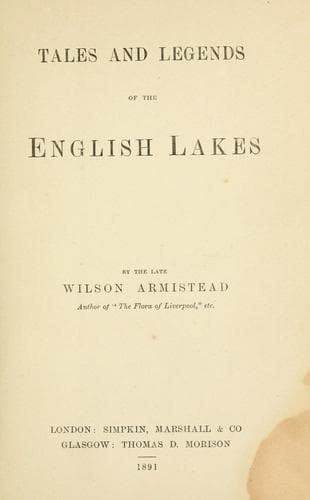
Tales and Legends of the English Lakes — John Shaqi
Tales and Legends of the English LakesArmistead, Wilson
General
Tales and Legends of the English Lakes
Armistead, Wilson
Folklore -- England -- Lake District; Legends -- England -- Lake District; Tales -- England -- Lake District
Sir Ferdinand was grievously disappointed in his scheme; for the lovely
Helwise had buried her heart in the same grave that held the remains of
her sleeping lover. It was in vain that Sir Ferdinand urged the
tenderness and sincerity of his passion. She was deaf to his entreaties.
Her heart was cold, and no human power could warm it. The noisy mirth of
the hall she could hear unmoved; the mazy intricacies of the festive
dance could not reanimate her; the glowing beauties of the summer
landscape were gloomy and dull as December. She resolved to seclude
herself from the giddy world, and brood over her own sorrows in a
nunnery. She therefore retired to the Benedictine Convent of Maiden
Castle--the ruins of which are still visible behind higher end of Soulby
Fell; where she passed her few remaining days in piety and silent
solitude.
The conscience of Sir Ferdinand left him no repose; and, to stifle
recollections which became continually more insupportable, he joined the
army, and soon after fell in the battle of Bosworth Field, fighting
against the Earl of Richmond. He left a very handsome estate in the
neighbourhood of Kirksancton to St. Mary's Abbey of Furness, to purchase
masses for the repose of his own soul, and the soul of the young
carpenter.
ST. HERBERT,
THE HERMIT OF DERWENTWATER.
Amongst the beautiful isles of Derwentwater, that named St. Herbert's
Island deserves a more than ordinary notice, as well for its beauty as
its historical associations. This insulated paradise includes an extent
of four or five acres, well covered with wood, and is situated near the
centre of the lake. It obtained its name from St. Herbert, a priest and
confessor, who, "to avoid the intercourse of man, and that nothing might
withdraw his attention from unceasing mortification and prayer," about
the middle of the 7th century, chose this island for his lonely abode.
"St. Herbert hither came,
And here for many seasons, from the world
Removed, and the affections of the world,
He dwelt in solitude."
The locality was well adapted to the severity of his religious life; he
was surrounded by the lake, from whence he received his simple diet. On
every hand the voice of waterfalls excited the most solemn strains of
meditation--rocks and mountains were his daily prospect, inspiring his
mind with ideas of the might and majesty of the Creator.
That St. Herbert had his hermitage on this island is certain from the
authority of the venerable Bede, as well as from tradition, and nowhere
could ancient eremite find more profound peace, or a place of so great
beauty, whence to bear on the wings of imagination his orisons to
heaven.
Public-domain text, read in full here on John Shaqi.
Reviews
Reviews
No reviews yet
Be the first to share your thoughts on this work.
Join the Discussion
Join the discussion
Sign in to leave a comment or review.
Sign InorCreate an account