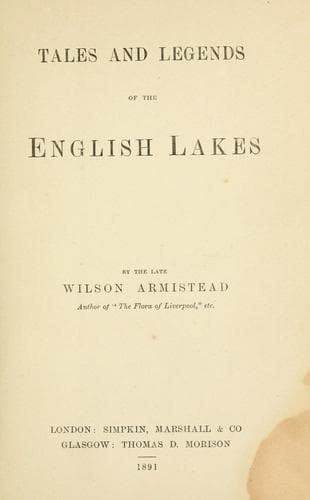
Tales and Legends of the English LakesArmistead, Wilson
General
Tales and Legends of the English Lakes
Armistead, Wilson
Folklore -- England -- Lake District; Legends -- England -- Lake District; Tales -- England -- Lake District
Among the various traits of local character in the English Lake
district, there is not perhaps, one more amusing than that propensity to
rhyming which a number of individuals has exhibited, in all the rustic
grace of native ignorance. A few instances of this nature can only be
admitted within the limited compass of these pages, but they will not be
without their interest to those who feel a pleasure in tracing the
unassisted efforts of natural genius.
John Oldland was an inhabitant of Crosthwaite, existing about the
beginning of the last century. His propensity to rhyming was such, that
many of his rhymes, as they are provincially called, are still repeated
by the older inhabitants of the neighbourhood. A few, and but a few of
these rhymes, we shall here insert.
When he attended Ulverston market, as he generally did, he put up at the
Dog, in Dalton Gate, then kept by Betty Woodburn and her husband, though
now gone and forgotten. Audland, as he was called, was so much addicted
to rhyming, that he did it on all occasions with various success; the
following, though still remembered, is one of his clumsy
attempts:--Calling one Thursday at the public-house door with some other
farmers, the landlord replied in his politest manner, "Coming, Sir." On
which Audland, looking up at the sign, observed:--
"This dog he runs wi' his tail to the south,
But co' on the landlord, an' he'll gi' mouth."
Once when his landlady, at the Dog, had urged him to clear off a long
score, which he had run up at the house, he gave her the following
promissory note, which was accepted:--
"I, John Oldland,
Befoar I gang hence,
Owe Betty Woodburn
Just six and two pence.
An', Thursday come sennet,
I'll pay off the auld scoar,
An' wha knas but I may
Spend twice as mich moar."
The smartest of John's rhymes was made on the occasion of his being put
to trouble (as it is properly termed in the provincial dialect) by a
lawyer, for some debt which he had incurred at Ulverston; a proof that
not only poets, but all who meddle with rhyme, are poor. John repeated
with emphasis--
"God mead men,
An' men mead money;
God mead bees,
An' bees mead honey;
But the D--l mead lawyers an' tornies,
An' pleac'd 'em at U'ston and Daltan i' Forness."
We shall only have room to notice another of these "rustic bards." He
too was a Crosthwaite man, but of a more recent date. We do not intend
to insinuate that there is any predisposing cause about Crosthwaite,
that inclines the inhabitants to rhyme, but it happens that we remember
these two at the present moment; by an association of ideas, the one has
probably conjured up the other.
Jamie Muckelt was undoubtedly the best rhymer in that part of the
country; and, consequently his rhymes have been more carefully preserved
than those of any other. We have room, however, for only a few
specimens.
Public-domain text, read in full here on John Shaqi.
Reviews
Reviews
No reviews yet
Be the first to share your thoughts on this work.
Elsewhere in the archive
Join the Discussion
Join the discussion
Sign in to leave a comment or review.
Sign InorCreate an account