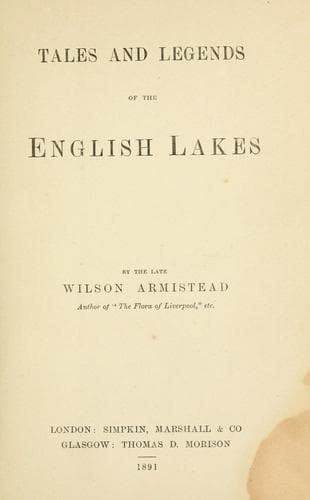
Tales and Legends of the English LakesArmistead, Wilson
General
Tales and Legends of the English Lakes
Armistead, Wilson
Folklore -- England -- Lake District; Legends -- England -- Lake District; Tales -- England -- Lake District
Jamie was a farmer; and once, returning from the market he had overset,
or, as he called it, capsized the cart. His wife was angry, and eagerly
inquired the cause of such an accident. Jamie, with that _sang froid_
for which he was so remarkable, only replied,
"Caerlessly, thou may depend--
Pooin' away at t' helter end."
A common footpath led through a field in which Jamie had a crop of pease
one year. These held out a temptation, Jamie considered, to passengers
to be taking tithe in kind. To prevent these depredations he fixed up a
board, on which he painted or chalked the following lines:--
"Pray ye, nebbers, dunnet pull;
I'll gi' ye a pey-scode when they're full.
If ye it 'em when they're swash,
They'll fill yer belly full o' trash."
Muckelt happened once to be at the Punch Bowl in Crosthwaite, in company
with Dr. Bell. Jamie's rhyming abilities were pretty well known, and
perhaps sometimes a little envied. Be that as it may, the Doctor
challenged Jamie to rhyme him for a wager. Jamie, without a moment's
study, produced the following stanza:--
"At your request,
I'll du me best;
But ya' thing I implore--
If Dr. Bell
Can du as well,
To trouble me no more."
The Doctor acknowledged himself outdone, and paid his forfeit.
On another occasion Jamie had staid at the Punch Bowl till he was rather
top-heavy, and fell into the fire and burnt himself. The next day he
went to the house to discharge his bill, and gave them, in addition to
their regular charge, the following verse:--
"Thear is some men, for want o' sense,
Will run ther sels to vast expense;
An' I mesel, for want o' greace,
Fell into t' fire an' burnt me feace."
Meeting with a friend one day, in the shambles at Kendal, he said,
"Come, nebber, let us join,
If thou'll buy t' leg I'll buy t' loin;
If thou'll buy t' head I'll buy t' pluck;
An' we'll hev a quart at t' Dog an' Duck."
Many other instances of this rhyming propensity, through all the
country, might be produced, would our limits permit.
THE HART'S-HORN TREE.
A TRADITION OF PENRITH.
Public-domain text, read in full here on John Shaqi.
Reviews
Reviews
No reviews yet
Be the first to share your thoughts on this work.
Elsewhere in the archive
Join the Discussion
Join the discussion
Sign in to leave a comment or review.
Sign InorCreate an account