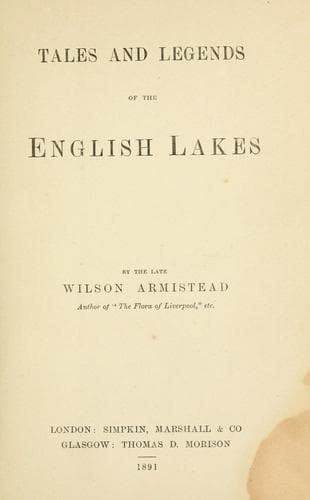
Tales and Legends of the English LakesArmistead, Wilson
General
Tales and Legends of the English Lakes
Armistead, Wilson
Folklore -- England -- Lake District; Legends -- England -- Lake District; Tales -- England -- Lake District
The moon shone full upon the dial of Saint Paul's, and showed the
hour-pointer far advanced towards midnight, as Edward Fletcher paused
for a moment to inquire the time, and then pursued his way in deep and
silent meditation. At an early age, by the death of both his parents, he
had been left to the care of an unmarried uncle, who, after giving him a
good education, had placed him in a merchant's office, and had since
enabled him to become the principal of a mercantile establishment. He
had now been for two years the master of a lucrative and increasing
business, and being naturally of a social disposition, he began to court
the company of those of his own rank. In this way he had spent the
evening, and, having accompanied some of his fair companions to their
homes, he was returning to his own lodgings in a distant part of the
metropolis. The warm and genial influence of Society had called into
action the softer emotions of his heart, freed them from the icy fetters
which long and arduous attention to business had thrown over them, and
caused them again to burst forth and to roll onward in an unbroken
current, bearing his thoughts to that far distant period, when, in the
twilight of memory, the forms of past events are dim and indistinctly
visible.
And he lingered on the recollection with a melancholy pleasure, for it
was the happiest period of his existence. He was then the loved and
caressed of parents who were now no more. Those joyous days were passed
among the pleasant hills and valleys of Westmorland, and now he was
confined among the din and bustle of the city. He remembered one fair
girl, who was more than his playmate, with whom "he roamed about the
braes," pulling the cowslips or the early violets; or at evening sat
under the shadow of a spreading elm, telling her the stories which he
had read during the day, and listening to the little hymns which her
mother had taught her; but of her he knew nothing--she too, probably,
was with the dead.
Then he thought of his school-days, with their mischievous tricks and
their active sports, and their hard lessons, and the noble boys who were
his comrades. Some of them, the gentlest and the most beloved, were also
gone to their rest; and the hardy, the active, and enterprising, were
pursuing their separate courses of adversity or success; many, like
himself, were still bachelors, whilst others enjoyed the delights of
domestic felicity in the bosoms of their families. This last subject was
one on which he had often deeply pondered. Arrived at that time of life,
when the enthusiasm of youth has subsided, before the indifference of
age has commenced, he had long felt the solitude of his orphan state; he
had been convinced that he did not move in the sphere for which
Providence had designed him.
Public-domain text, read in full here on John Shaqi.
Reviews
Reviews
No reviews yet
Be the first to share your thoughts on this work.
Elsewhere in the archive
Join the Discussion
Join the discussion
Sign in to leave a comment or review.
Sign InorCreate an account