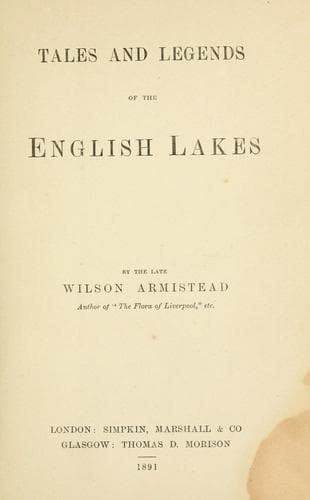
Tales and Legends of the English LakesArmistead, Wilson
General
Tales and Legends of the English Lakes
Armistead, Wilson
Folklore -- England -- Lake District; Legends -- England -- Lake District; Tales -- England -- Lake District
Four miles from Penrith, near the road to Appleby, and in the district
which, to this day, bears the name of Whinfell Forest, there formerly
stood a fine oak, which bore the name of Hart's-Horn Tree, a name it
acquired from a tradition to this effect. In the time of the first
Robert de Clifford, about the year 1333, Edward Baliol, King of
Scotland, came into Westmorland, and stayed some time with that Lord, at
his castles of Appleby, Brougham, and Pendragon. During his visit they
ran a stag by a single greyhound, out of Whinfell Forest to Redkirke in
Scotland, and back again to the same place. Being both spent, the stag
leaped over the pales, and died there; but the greyhound attempting to
leap, fell, and died on the opposite side. As a memorial of this
incident, the stag's horns were nailed upon a tree just by; and the dog
being named Hercules, this couplet obtained currency amongst the
people--
"Hercules kill'd Hart-a-grease,[15]
And Hart-a-grease killed Hercules."
"Then went they down into a laund,
These noble archers three;
Eche of them slew a hart of greece,
The best that they could see."
_Song of Adam Bell._
In course of time, it is stated, the horns became grafted, as it were,
upon the tree, by reason of its bark growing over their root, and there
they remained more than three centuries, till, in the year 1648, one of
the branches was broken off by some of the army; and ten years
afterwards, the remainder was secretly taken down by some mischievous
people in the night. "So, now," says Lady Ann Clifford, in her _Diary_,
"there is no part thereof remaining, the tree itself being so decayed,
and the bark of it so peeled off, that it cannot last long; whereby we
may see time brings to forgetfulness many memorable things in this
world, be they ever so carefully preserved--for this tree, with the
hart's horn in it, was a thing of much note in these parts."
In another part of the same forest, which, like many other forests in
this country, as Skiddaw forest, Inglewood forest, &c., has no trace of
what it has been but the name, there stood, a few years ago, three
enormous oak trees, known by the name of the "Three Brothers." One of
them measured thirteen yards in girth.
[15] Dr. Percy, in a note to the poem, a stanza of which is given
below, explains "heart o' grease," or "greece," to mean a fat
animal, from the French word _graisse_.
THE QUAKERESS BRIDE.
A TALE OF THE MOUNTAINS.
Public-domain text, read in full here on John Shaqi.
Reviews
Reviews
No reviews yet
Be the first to share your thoughts on this work.
Elsewhere in the archive
Join the Discussion
Join the discussion
Sign in to leave a comment or review.
Sign InorCreate an account