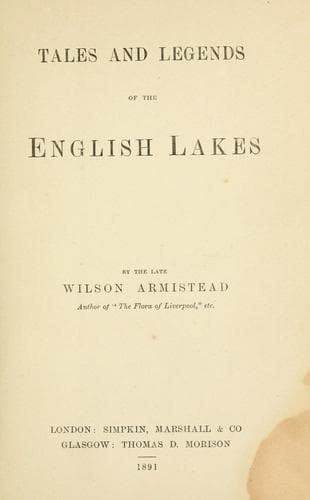
Tales and Legends of the English LakesArmistead, Wilson
General
Tales and Legends of the English Lakes
Armistead, Wilson
Folklore -- England -- Lake District; Legends -- England -- Lake District; Tales -- England -- Lake District
"John Hatfield, who lately married a young woman, commonly called
the Beauty of Buttermere, under an assumed name; height about five
feet ten inches, aged about forty-four, full face, bright eyes,
thick eyebrows, strong, but light beard, good complexion, with some
colour, thick, but not very prominent nose, smiling countenance,
fine teeth, a scar on one of his cheeks near his chin, very long
thick light hair, and a great deal of it gray, done up in a club;
stiff, square-shouldered, full breast and chest, rather corpulent,
and strong limbed, but very active; and has rather a spring in his
gait, with apparently a little hitch in bringing up one leg; the
two middle fingers of his left hand are stiff from an old wound; he
has something of the Irish brogue in his speech; fluent and elegant
in his language, great command of words, frequently puts his hand
to his heart; very fond of compliments, and generally addressing
himself to persons most distinguished by rank or situation;
attentive in the extreme to females, and likely to insinuate
himself where there are young ladies. He was in America during the
war; is fond of talking of his wounds and exploits there, and of
military subjects, as well as of Hatfield Hall, and his estates in
Derbyshire and Cheshire; and of the antiquity of his family, whom
he pretends to trace to the Plantagenets. He makes a boast of
having often been engaged in duels; he has been a great traveller
also, by his own account, and talks of Egypt, Turkey, and Italy;
and, in short, has a general knowledge of subjects, which, together
with his engaging manners, is well calculated to impose on the
credulous. He had art enough to connect himself with some very
respectable merchants in Devonshire, as a partner in business, but
having swindled them out of large sums, he was made a separate
bankrupt in June, 1802. He cloaks his deception under the mask of
religion, appears fond of religious conversation, and makes a point
of attending divine service and popular preachers."
Besides blighting the prospects of the poor girl, he had nearly
ruined her father by running up a debt of eighteen pounds. His
dressing-case, a very elegant piece of furniture, was left behind,
and on being opened at Keswick by warrant of a magistrate, was
found to contain every article that the most luxurious gentleman
could desire, but no papers tending to discover his real name.
Afterwards, Mary herself, searching more narrowly, discovered that
the box had a double bottom, and in the intermediate recess, found
a number of letters addressed to him by his wife and children,
under the name of Hatfield. The story of the detection immediately
became as notorious as the marriage had been.
Public-domain text, read in full here on John Shaqi.
Reviews
Reviews
No reviews yet
Be the first to share your thoughts on this work.
Elsewhere in the archive
Join the Discussion
Join the discussion
Sign in to leave a comment or review.
Sign InorCreate an account